
Research often begins with a simple question: What can we learn from the information available to us?
Whether researchers are studying customer behaviour, business performance, public opinion, or scientific trends, collecting and analysing data helps them find meaningful answers. However, there is one important challenge that can easily affect the entire research process: choosing which data to study.
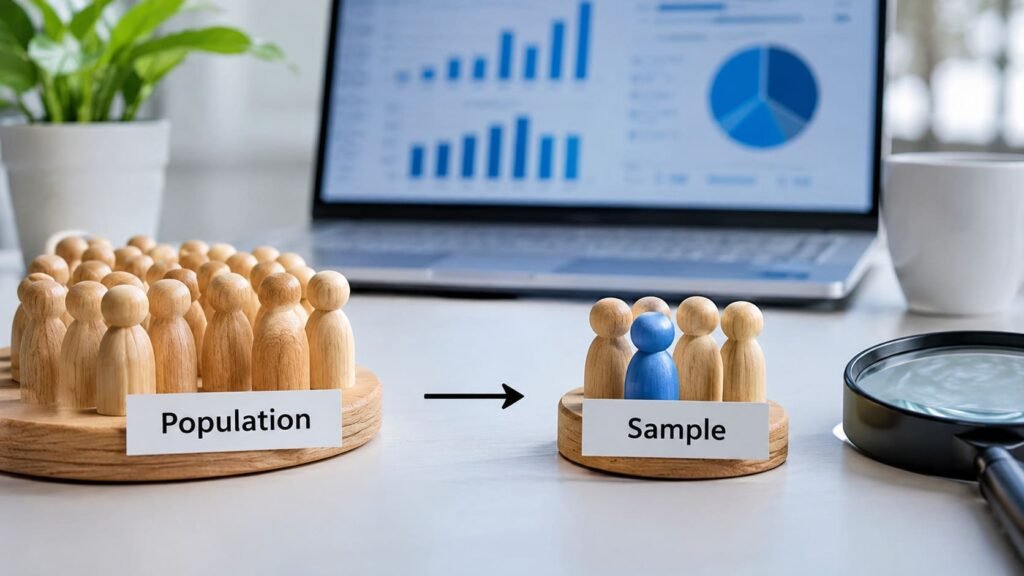
In many situations, examining every individual or record is simply not practical. Researchers therefore select a smaller group, known as a sample, and use it to understand a much larger population.
This approach saves time, reduces costs, and makes research easier to manage. But sampling also introduces a risk. If the selected group does not properly represent the population, the findings may tell a very different story from reality.
A research report can contain accurate calculations, detailed charts, and impressive statistics while still reaching the wrong conclusion. Sometimes, the problem is not the analysis itself. It is the data that researchers selected before the analysis even began.
What Is Data Sampling?
Data sampling is the process of selecting a smaller portion of a larger dataset or population for research and analysis.
For example, a company may have 50,000 customers but only enough resources to conduct a survey with 1,000 of them. Instead of contacting every customer, the company selects a sample and studies their responses.
The objective is to understand the wider customer population by examining a smaller group.
When the sample is selected carefully, it can provide useful and reliable insights. However, when the selection process is poorly planned, the results may reflect the characteristics of the sample rather than the population as a whole.
This difference is important because researchers often use sample findings to make decisions that affect thousands of people.
How Data Sampling Can Produce Misleading Results
1. The Sample May Not Represent the Entire Population
One of the most common sampling problems occurs when the selected group does not reflect the diversity of the population being studied.
Imagine a company wants to understand how satisfied its customers are with a new service. It sends a survey only to customers who recently made a purchase.
These customers may have had a positive experience and may be more likely to respond favourably.
However, the survey excludes customers who stopped using the service months ago or experienced problems during their first interaction.
As a result, the research may suggest that customer satisfaction is extremely high, even though a significant number of customers are unhappy.
A representative sample should include the different groups that exist within the population, not just the easiest people to reach.
2. A Larger Sample Does Not Always Mean Better Research
Many people assume that collecting more data automatically improves research accuracy.
Although a larger sample can reduce random sampling error, it cannot necessarily correct a poor selection process.
For example, a survey involving 20,000 people from the same professional group may provide less useful information about the general population than a carefully selected sample of 2,000 people from different backgrounds.
If the sample contains the same underlying bias, increasing its size may simply make the misleading result appear more convincing.
The quality of the sample matters just as much as its quantity.
3. Sampling Bias Can Influence Research Findings
Sampling bias occurs when certain individuals or groups have a greater chance of being selected than others.
This can happen in several ways.
Researchers may choose participants who are easy to contact, rely on voluntary survey responses, or collect information from a single location.
Consider a study about digital banking habits. If researchers collect responses only from people who regularly use mobile banking applications, they may underestimate the number of people who still prefer traditional banking services.
The research may be technically correct for the selected group, but it cannot automatically be applied to everyone.
Sampling bias becomes especially problematic when researchers fail to recognise that their sample represents only a particular segment of the population.
4. Small Samples Can Miss Important Differences
A small sample may not include enough participants from specific groups to reveal meaningful patterns.
For example, a business researching customer preferences may collect responses from 100 people. Most participants might belong to one age group, while only a few represent older customers.
The findings may accurately describe the majority group but provide very little information about the preferences of other customers.
This becomes a problem when businesses use the results to develop products, marketing campaigns, or customer service strategies for a much wider audience.
A sample should be large enough to capture important differences within the population, particularly when those differences influence the research objective.
5. Outdated Sampling Data Can Create Incorrect Conclusions
Research findings can also become misleading when the sample is based on old or incomplete information.
Customer preferences, market conditions, technology usage, and business behaviour change over time.
A company that studies customer preferences using a database collected several years ago may overlook recent changes in purchasing habits.
Even if the original sample was representative, it may no longer reflect the current population.
This is why researchers need to consider when the data was collected and whether the population has changed since then.
Reliable sampling requires more than selecting the right people. It also requires selecting information that remains relevant to the research question.
Real-World Example: A Misleading Customer Satisfaction Survey
Imagine an online retail company wants to measure customer satisfaction after introducing a new delivery service.
The company sends a survey to 5,000 customers who received their orders successfully within two days.
Most customers report that they are satisfied with the service.
Based on these responses, the company concludes that its delivery system is performing well.
However, the survey does not include customers whose orders were delayed, cancelled, or lost.
These customers may have had the most serious delivery problems, but they were excluded from the research.
The company now has a large amount of survey data, yet its findings do not reflect the complete customer experience.
This example shows how a sampling decision can influence the final conclusion before any statistical analysis takes place.
The issue is not necessarily that the respondents provided incorrect answers. The issue is that the selected respondents did not represent the entire customer population.
Why Misleading Sampling Results Matter for Businesses
Poor sampling can affect more than research reports. It can influence important business decisions.
Incorrect Business Strategies
When companies rely on unrepresentative research, they may develop strategies that do not address the needs of their actual customers.
For example, a business may invest heavily in a product feature that appears popular among a small group but has little demand across the wider market.
Wasted Marketing Budgets
Marketing teams often use research findings to identify customer segments and understand purchasing behaviour.
If the sample excludes important customer groups, businesses may target the wrong audience or overlook valuable market opportunities.
Unreliable Forecasting
Sampling errors can influence sales forecasts, demand estimates, and market predictions.
If the selected data does not reflect current market conditions, forecasts may become less reliable and lead to poor planning.
Reduced Confidence in Research
When organisations repeatedly make decisions based on misleading findings, employees and stakeholders may begin to question the value of research itself.
Reliable sampling helps build confidence in the conclusions drawn from data.
How Researchers Can Reduce Sampling Errors
Sampling errors cannot always be eliminated completely, but researchers can take several steps to reduce their impact.
Define the Population Clearly
Before collecting data, researchers should identify exactly who or what they want to study.
A clearly defined population helps prevent the accidental exclusion of relevant groups.
Choose an Appropriate Sampling Method
Different research objectives require different sampling methods.
Random sampling gives eligible members of a population a chance of being selected. Stratified sampling divides the population into meaningful groups and selects participants from each group.
The right method depends on the research question, available data, and characteristics of the population.
Ensure the Sample Reflects Important Groups
Researchers should examine whether the sample includes the major characteristics of the population, such as age groups, locations, customer types, or professional backgrounds.
This is particularly important when the research findings will be used to make decisions affecting different segments.
Review the Data Collection Process
Researchers should consider who was contacted, who responded, and who may have been excluded.
A survey with a high response count can still produce misleading results if certain groups are less likely to participate.
Use Reliable and Updated Data
The information used to select participants should be accurate and relevant to the current research.
Outdated records, incomplete databases, and duplicate entries can affect the sampling process and reduce the usefulness of the findings.
Be Transparent About Limitations
Every research project has limitations.
Researchers should clearly explain how the sample was selected, how large it was, and which groups may not have been adequately represented.
Being transparent about these limitations helps readers understand what the findings can and cannot establish.
Conclusion
Data sampling is an essential part of modern research. It allows researchers to study large populations without examining every individual record.
However, sampling is not simply about collecting a smaller amount of data. It is about selecting the right data to answer the research question.
A poorly selected sample can hide important differences, exclude relevant groups, and create conclusions that do not reflect reality. Even a large dataset cannot fully overcome these problems when the selection process is biased.
For businesses and researchers, the lesson is straightforward: meaningful research begins with thoughtful data selection.
When sampling methods are carefully planned, findings become more representative, decisions become better informed, and data can provide a more dependable picture of the world being studied.
Frequently Asked Questions
1. What is data sampling in research?
Data sampling is the process of selecting a smaller group from a larger population to study its characteristics.
2. How can data sampling lead to misleading results?
Results may become misleading when the sample does not represent the entire population or contains sampling bias.
3. Does a larger sample always provide accurate results?
No. A large sample can still produce inaccurate results if it is selected using a biased method.
4. How can researchers reduce sampling errors?
Researchers can reduce errors by using suitable sampling methods and ensuring different population groups are represented.