Plastic pollution is no longer limited to bottles, bags, and packaging floating in rivers or washing up on beaches. Much of it breaks into particles so small that they cannot be seen with the naked eye. These tiny fragments, known as microplastics and nanoplastics, have become an important subject of scientific research because they can move through water, soil, air, and living environments.
But how can researchers find something they cannot easily see? They use a combination of careful sample collection, laboratory preparation, advanced microscopes, and chemical analysis. These methods help scientists determine whether tiny particles are plastic, what type of material they contain, and how much is present in a sample.
Understanding these techniques is an important step toward measuring plastic pollution more accurately and discovering where it travels.
What Makes Microplastics Difficult to Detect?
Microplastics are commonly defined as plastic particles smaller than five millimeters. Some are produced in small sizes for specific applications, while others form when larger plastic objects gradually break apart through sunlight, weathering, friction, and other environmental processes.
As these fragments become smaller, identifying them becomes increasingly difficult. A particle may look like dust, a natural fiber, or a tiny piece of organic material. Its color and shape alone cannot reliably establish whether it is plastic.
Nanoplastics present an even greater challenge because they are smaller than one micrometer under a commonly used scientific definition. Many particles at this scale require specialized instruments and carefully designed experiments for detection.
Scientists must also work with complicated samples. River water, seawater, soil, and biological material contain minerals, salts, natural fibers, and organic matter that can interfere with measurements. Even airborne fibers from clothing or laboratory equipment can accidentally enter a sample.
For these reasons, reliable microplastic research requires more than simply looking through a microscope.
1. Collecting Samples Without Contamination
The first stage of tracking microplastics begins outside the laboratory. Researchers collect samples from locations such as rivers, oceans, wastewater facilities, agricultural soil, and even the air.
The collection method depends on what scientists want to investigate. Water samples may be filtered to concentrate suspended particles, while soil and sediment samples require procedures that separate plastic fragments from grains and other materials.
Preventing contamination is especially important. Researchers may use glass or metal equipment where appropriate, cover samples during handling, and run blank samples through the same procedure without the environmental material. These blanks help reveal whether plastic entered the sample during collection or testing.
Scientists also record where and when each sample was collected. This information makes it possible to compare locations, examine changes over time, and investigate potential sources of pollution.
Without careful sampling, even sophisticated laboratory instruments can produce misleading results.
2. Using Microscopes to Find Tiny Particles
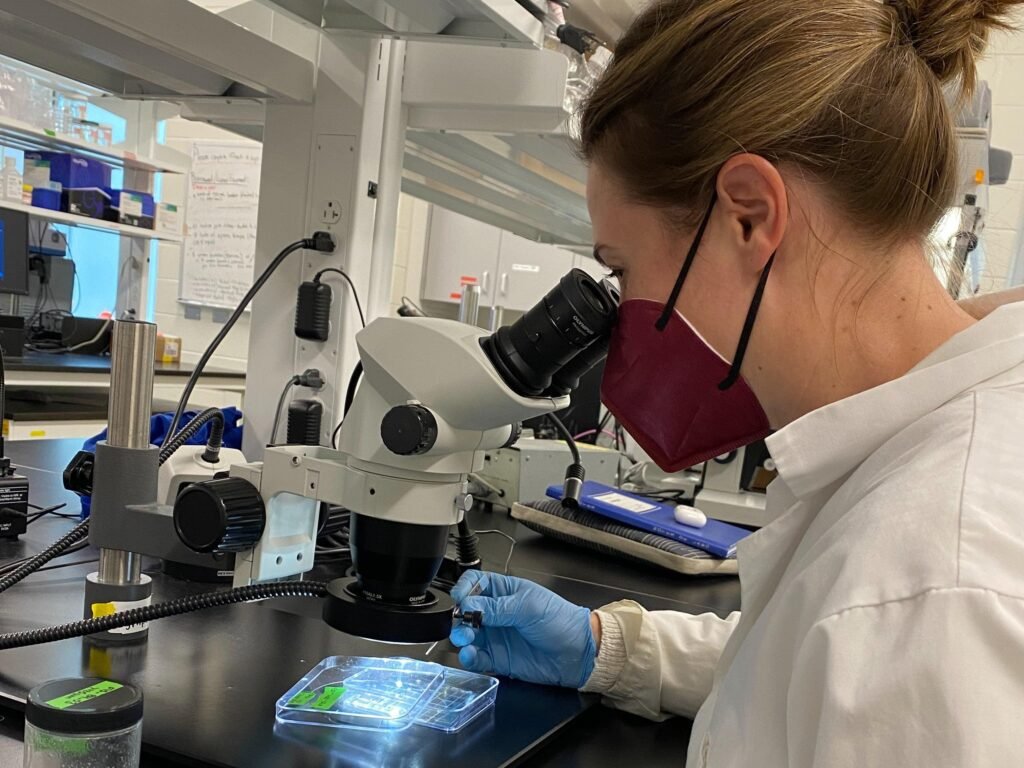
Microscopy is often one of the first steps in examining a sample. After preparation and filtration, researchers inspect the collected material under magnification.
A microscope can reveal the physical features of suspected plastic particles, including their size, shape, color, and surface texture. Scientists may identify fragments, thin films, fibers, or small spherical particles for further examination.
Digital imaging software can also help researchers measure particles and organize large collections of images. Automated image analysis may speed up the process by identifying objects with particular shapes or sizes.
However, microscopy has an important limitation: a particle that looks like plastic is not necessarily plastic. Natural fibers and other materials can resemble synthetic polymers.
For this reason, microscopy is often combined with chemical identification techniques. The visual evidence helps researchers locate possible particles, while additional testing provides stronger evidence about their composition.
3. Identifying Plastics With Infrared Spectroscopy
One widely used method is Fourier-transform infrared spectroscopy, commonly called FTIR. It helps researchers identify materials by measuring how they interact with infrared light.
Different plastic polymers have different molecular structures. When infrared light interacts with a material, it produces a characteristic pattern that scientists can compare with reference spectra from known substances.
This process works much like checking a chemical fingerprint. If the measured pattern matches a known polymer, researchers can identify materials such as polyethylene, polypropylene, or polystyrene.
Microscopy combined with FTIR allows researchers to examine individual particles and associate their physical appearance with their chemical identity.
The technique is valuable for environmental monitoring, but it has limits. Conventional infrared analysis may struggle with very small particles, and sample preparation can affect the results. Researchers must select instruments suited to the size and type of plastic they want to measure.
4. Using Raman Spectroscopy for Smaller Particles
Raman spectroscopy offers another way to identify tiny plastic fragments. Instead of measuring infrared absorption, it examines changes in the light scattered by a sample when a laser illuminates it.
These changes reveal information about molecular vibrations and chemical composition. Researchers compare the resulting spectrum with reference data to determine which material may be present.
Microscopic Raman analysis can identify particles smaller than those typically accessible to many infrared imaging systems. Under suitable conditions, it can analyze particles around one micrometer in size, although practical performance depends on the instrument and sample.
Raman spectroscopy is particularly useful when researchers need detailed information about small particles. Nevertheless, it is not perfect. Some environmental materials produce fluorescence that can obscure the signal, and certain samples require extensive preparation before analysis.
By combining Raman results with microscopy or other analytical methods, researchers can improve their understanding of the particles collected from the environment.
5. Measuring Plastic With Heat-Based Chemical Analysis
Sometimes scientists need to determine how much plastic a sample contains rather than count every individual particle.
For this purpose, researchers can use pyrolysis coupled with gas chromatography and mass spectrometry, commonly called Py-GC-MS.
In this technique, a prepared sample is heated under controlled conditions, breaking its polymer components into smaller chemical compounds. A gas chromatograph separates these compounds, and a mass spectrometer helps identify them.
The resulting chemical signals can be used to estimate the amount of particular plastic polymers in a sample.
One advantage is that the technique can measure polymer mass even when individual particles are difficult to distinguish visually. However, the process destroys the material being analyzed and generally does not provide the number, shape, or size distribution of individual particles.
This means heat-based analysis answers a different question from particle imaging. Scientists choose the method according to whether they need a particle count, a chemical identification, a mass measurement, or several types of information together.
6. How Scientists Study Nanoplastics
Nanoplastics are especially challenging because their dimensions can fall below the practical detection limits of commonly used microplastic methods.
Researchers are investigating several approaches to study these particles, including advanced microscopy, specialized spectroscopy, thermal analysis, and techniques that measure particle behavior in liquids.
Each method has different strengths. Some can provide information about particle size or physical structure, while others reveal chemical composition or estimate the total amount of polymer present.
The difficulty is that a method capable of detecting a tiny particle does not always establish that the particle is plastic. Similarly, a technique that identifies a polymer in a sample may not reveal how many separate nanoparticles are present.
Scientists therefore need methods that can distinguish plastic particles from natural materials while minimizing contamination and measurement errors.
Research is continuing to improve the sensitivity, reliability, and consistency of nanoplastic measurements. There is no single technique that can answer every question across all sample types.
7. Turning Laboratory Results Into Environmental Data
Finding plastic particles in one sample is only part of the investigation. Scientists also need to understand how contamination differs between locations and changes over time.
Researchers compare samples from different environments, examine particle sizes and polymer types, and use repeated measurements to identify patterns. For example, studies may investigate whether a river carries different types of plastic during wet and dry seasons or whether wastewater treatment changes the amount of plastic released into the environment.
Reliable comparisons depend on consistent sampling procedures and transparent reporting. If two laboratories use different collection methods or detection limits, their results may not be directly comparable.
Researchers must also distinguish between particle counts and polymer mass. A sample containing many very small particles may produce a different result from one containing fewer but larger fragments.
Combining several forms of evidence helps scientists develop a more complete picture of plastic pollution and its movement through ecosystems.
Challenges That Researchers Still Face
Despite improvements in analytical technology, microplastic detection remains a developing field. Several challenges continue to influence the accuracy of scientific measurements.
- Contamination: Airborne fibers and plastic laboratory materials can introduce particles into samples.
- Extremely small sizes: Some microplastics and nanoplastics fall below the detection limits of commonly available instruments.
- Complex samples: Natural organic matter, minerals, and other substances can interfere with analysis.
- Different testing methods: Variations in sample preparation and measurement procedures can produce results that are difficult to compare.
- Time and cost: Advanced instruments and detailed laboratory procedures can require substantial resources and trained specialists.
Researchers are working to improve standardized testing procedures, automate particle identification, and combine complementary analytical techniques. These improvements could make environmental measurements more consistent and useful for long-term monitoring.
Why Accurate Microplastic Detection Matters
Measuring microplastics accurately helps scientists understand where plastic pollution accumulates, how different materials behave in the environment, and which monitoring strategies may be most effective.
Better measurements can support research into water quality, soil health, aquatic ecosystems, and possible human exposure. However, detecting plastic in an environmental or biological sample does not automatically establish that it causes a particular health effect. Scientists must investigate exposure levels, biological responses, and other evidence to assess potential risks.
Reliable detection is therefore a foundation for further research rather than a complete answer to every question about plastic pollution.
The Future of Microplastic Tracking
The next generation of microplastic research is likely to rely on improved instruments, automated image processing, better chemical reference libraries, and more consistent testing protocols.
Artificial intelligence may help researchers screen large numbers of images and recognize patterns, while advanced analytical systems could improve the identification of very small particles. These tools will still need careful validation to ensure that their results are accurate.
Researchers are also working toward methods that can provide complementary information about particle size, chemical composition, and quantity within the same investigation.
The goal is not simply to find more plastic particles. It is to measure them reliably enough that scientists can compare findings, trace pollution pathways, and evaluate environmental changes over time.
Conclusion
Tracking microplastics that are too small to see requires a combination of scientific methods. Microscopes help locate suspected particles, infrared and Raman spectroscopy help identify their chemical composition, and heat-based techniques can measure the amount of certain polymers in a sample.
Each method reveals a different part of the story, and each has limitations. Careful sample collection, contamination controls, and standardized procedures are essential for producing trustworthy results.
As detection technology develops, scientists will gain better tools for studying the smallest forms of plastic pollution. That knowledge can help build a clearer understanding of how plastic moves through the natural world and support more informed decisions about managing waste and protecting ecosystems.
Frequently Asked Questions
1. How do scientists detect microplastics?
Scientists use microscopes, infrared spectroscopy, Raman spectroscopy, and chemical analysis to identify and measure tiny plastic particles in water, soil, air, and other samples.
2. What tools are used to identify microplastics?
Common tools include optical microscopes, FTIR spectroscopy, Raman spectroscopy, and pyrolysis-gas chromatography-mass spectrometry (Py-GC-MS).
3. Why are nanoplastics difficult to detect?
Nanoplastics are extremely small and difficult to distinguish from natural materials. Detecting them often requires specialized instruments and careful sample preparation.
4. Why is tracking microplastics important?
Tracking microplastics helps researchers understand how plastic pollution moves through the environment, where it accumulates, and how it may affect ecosystems and human exposure.