
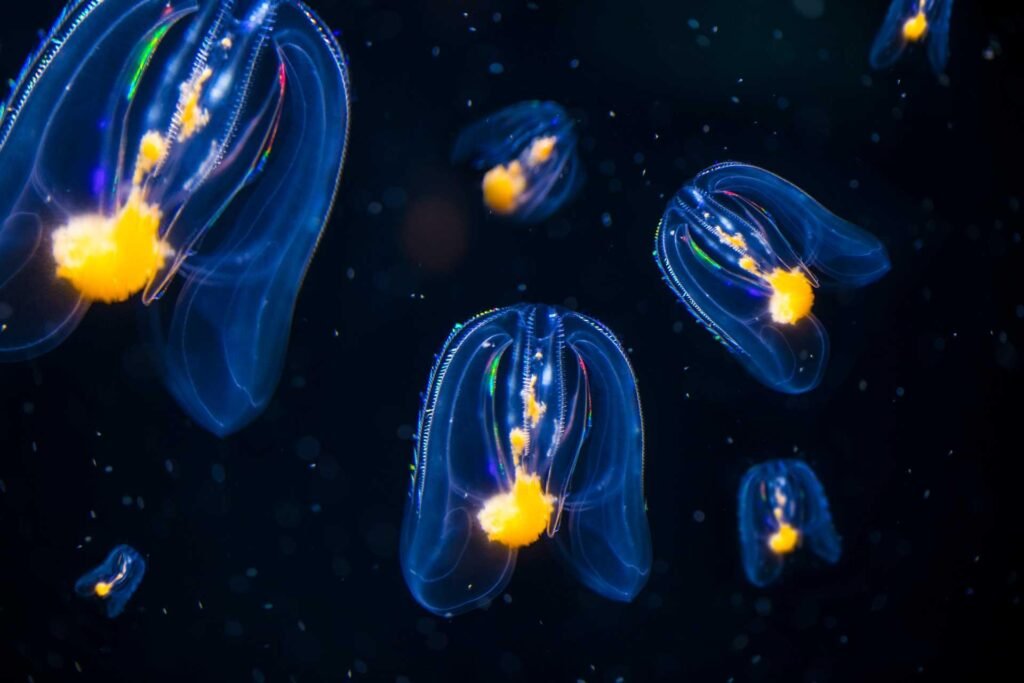
Imagine swimming through the deep ocean, where sunlight disappears and darkness surrounds almost everything. Suddenly, a tiny blue flash appears in the water. It might look like a spark from another world, but it could be a living creature producing its own light.
This remarkable ability is known as bioluminescence, and it is one of the most fascinating adaptations found in marine life. From glowing jellyfish to deep-sea fish with built-in lights, ocean creatures use this natural ability in different ways to survive in environments where finding food, avoiding predators, and locating a mate can be challenging.
But why do some marine animals glow while others do not? The answer lies in the chemistry of light and the unique demands of life underwater.
What Is Bioluminescence?
Bioluminescence is the production of light by a living organism through a chemical reaction. Unlike a glow-in-the-dark object that stores energy from an external light source, a bioluminescent animal generates light through biological processes.
In many organisms, a light-producing molecule called luciferin reacts with oxygen, with the help of an enzyme called luciferase or another catalyst. The reaction releases energy in the form of visible light. The exact chemicals and mechanisms differ between species.
The result is often a cool blue or blue-green glow. These colors travel relatively well through seawater, making them useful for communication and survival in the ocean.
According to the National Oceanic and Atmospheric Administration (NOAA), bioluminescence occurs across many marine environments, from surface waters to the deepest parts of the ocean. Scientists continue to investigate how this ability evolved and precisely how different species use it.
Why Is Light Important in the Deep Ocean?
As sunlight fades with increasing depth, the ocean becomes a difficult place to navigate. Many deep-sea animals live in environments where natural daylight provides little or no help.
Producing light can offer a useful advantage. Rather than relying entirely on sunlight, certain species have developed their own ways to create flashes, glowing spots, or steady sources of light.
This ability is not simply a beautiful display. Depending on the species, it can help an animal find food, escape danger, blend into its surroundings, or interact with other members of its kind.
However, bioluminescence does not serve the same purpose in every creature. Scientists still do not fully understand its role in all marine species.
1. Anglerfish Use Light to Attract Prey
The anglerfish is one of the best-known examples of a glowing deep-sea animal. Some species have a special structure extending from the head, often called a lure, that hangs in front of their mouths.
In certain anglerfish, the lure contains bioluminescent bacteria. These tiny organisms produce light, while the fish provides them with a place to live and access to nutrients.
In the darkness, the glowing lure can attract curious prey. When a smaller animal approaches closely enough, the anglerfish can capture it with a quick movement.
This strategy is particularly useful in places where food can be scarce. Instead of constantly chasing prey through the water, the fish can use its glowing lure to bring potential meals within reach.
2. Jellyfish Create Flashes to Confuse Predators
Some deep-sea jellyfish produce striking displays of blue light when disturbed. These flashes may startle an attacker or draw the attention of a larger predator toward the animal threatening the jellyfish.
One example is the Atolla jellyfish, which can produce a flashing ring of light. Scientists believe this display may act like a burglar alarm, attracting another predator that could interrupt an attack.
This defensive strategy demonstrates how light can be used in an unexpected way. Rather than hiding completely, an animal may use a bright display to change the situation around it.
Not every jellyfish uses light for the same reason, and the precise function of these displays can vary between species.
3. Some Fish Use Light to Hide in Plain Sight
Glowing might seem like the opposite of camouflage, but it can actually help certain deep-sea fish avoid being seen.
In the ocean’s twilight zone, faint sunlight can still filter down from above. A predator swimming beneath another animal may detect its silhouette against the brighter water overhead.
Some fish, including lanternfish and certain dragonfish, have light-producing organs on their undersides. By producing light that approximately matches the faint illumination from above, they can reduce the shadow their bodies cast.
This technique is called counterillumination. It makes the fish harder to distinguish from the surrounding water when viewed from below.
The strategy highlights an important point: light is not always used to stand out. In the right conditions, it can help an animal disappear into its environment.
4. Glowing Shrimp Can Distract Their Enemies
Some deep-sea shrimp use light as part of their escape strategy. When threatened, certain species release a cloud of glowing material into the surrounding water.
The sudden flash or luminous cloud may distract an attacking predator, giving the shrimp an opportunity to swim away. In some cases, the display may also attract a larger predator that threatens the original attacker.
This is a clever form of defense because it allows the animal to influence what its enemy sees and how it responds.
For a small creature living in a dark ocean, a brief burst of light can create a valuable opportunity to escape.
5. Light May Help Marine Animals Communicate
Finding a mate in the deep ocean can be difficult. Animals may live far apart, and visual signals are limited by darkness and the distance light can travel underwater.
Some marine species have light-producing organs or patterns that researchers believe may help with recognition, courtship, or other interactions.
Different flashes, positions, and rhythms could carry information, although the details are not fully understood for many species. A signal that works for one animal may have a completely different meaning for another.
Studying these behaviors helps scientists explore how marine life communicates in places where sound, chemical signals, and light all play different roles.
How Do Ocean Creatures Produce Different Colors of Light?
Marine bioluminescence is often blue or blue-green, partly because these wavelengths travel relatively well through seawater. Red light, by comparison, is absorbed more quickly.
However, the color of the light depends on the organism and its biological chemistry. Some species produce greenish or yellowish light, while others can generate different colors under particular conditions.
It is also important to distinguish bioluminescence from biofluorescence. A bioluminescent organism creates light through a chemical reaction. A fluorescent organism absorbs light from an external source and re-emits it at a different wavelength.
Both processes can make marine animals appear to glow, but they work in different ways.
What Scientists Still Don’t Know
Despite advances in underwater cameras, research equipment, and deep-sea exploration, many questions about bioluminescence remain unanswered.
Observing these animals in their natural environment is difficult. Artificial lighting can disturb sensitive species, and some creatures are fragile or hard to collect without damaging them.
Researchers are still investigating how bioluminescence evolved in different groups, why it is widespread among animals in the open ocean, and what specific functions it serves in species that have not been studied closely.
Understanding these mechanisms could also provide useful insights beyond marine biology. Research into light-producing chemicals has contributed to scientific tools used in biological research, including methods for tracking cellular processes.
The ocean’s natural light shows how much remains to be discovered beneath the surface.
Why Bioluminescence Matters to Ocean Research
The study of glowing marine animals helps scientists understand how organisms adapt to extreme environments. It also reveals how life can use chemical reactions to solve practical challenges, from locating food to avoiding predators.
As underwater exploration improves, researchers can observe these animals with less disturbance and investigate their behavior more accurately. New discoveries may reveal unfamiliar species, unexpected light-producing mechanisms, and survival strategies that were previously difficult to document.
Bioluminescence is therefore more than an unusual natural spectacle. It offers a window into the relationship between chemistry, evolution, and life in the ocean.
Conclusion
Some ocean creatures produce their own light because it gives them useful ways to survive in a world where sunlight is limited. Anglerfish can use glowing lures to attract prey, jellyfish may flash to discourage attackers, and certain fish use light to make their bodies less visible.
Each example demonstrates how marine animals have adapted to the challenges of underwater life. Yet the ocean still holds many unanswered questions about these living lights.
The next time you see footage of a glowing jellyfish or a fish shining in the darkness, remember that the light is not merely beautiful. It may be part of a carefully developed survival strategy shaped by life in one of Earth’s most mysterious environments.
Frequently Asked Questions
1. Why do some ocean creatures produce their own light?
Some ocean creatures produce light through bioluminescence to attract prey, avoid predators, communicate, or camouflage themselves in dark underwater environments.
2. What is bioluminescence in marine animals?
Bioluminescence is the natural production of light by living organisms through a chemical reaction. It occurs in many marine species, including certain fish, jellyfish, and shrimp.
3. Which ocean animals can produce their own light?
Anglerfish, lanternfish, some jellyfish, and certain deep-sea shrimp are examples of marine animals that produce light. Some species create light themselves, while others rely on light-producing bacteria.
4. Why is bioluminescence usually blue or green?
Blue and blue-green wavelengths travel relatively well through seawater, making them useful for signaling and survival underwater. However, the colors produced vary among species.