
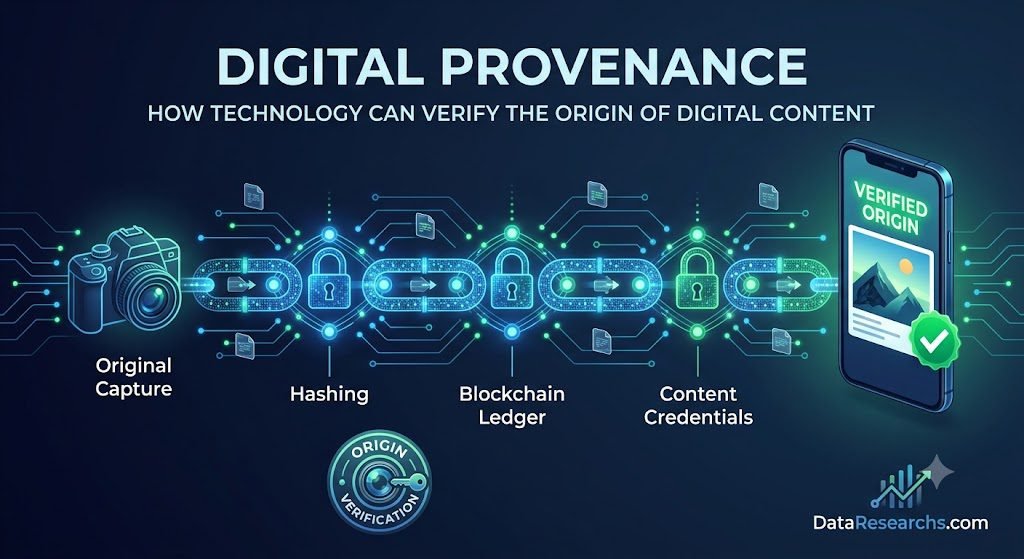
Every day, people share thousands of photos, videos, documents, and articles across the internet. Some are genuine, while others may be edited, taken out of context, or created using artificial intelligence. As digital content becomes easier to produce and modify, identifying where information originally came from is becoming increasingly important.
This is where digital provenance plays a valuable role. It helps people understand the origin of a digital file, who created or modified it, and what information is available about its history. Instead of judging content only by how realistic it looks, users can examine supporting records that provide additional context.
Digital provenance is becoming relevant to journalism, cybersecurity, online publishing, business communication, and digital marketing. It offers a way to improve transparency and make more informed decisions about the information people encounter online.
What Is Digital Provenance?
Digital provenance refers to the recorded history of a digital asset, including its origin, ownership information, and changes made during its lifecycle.
A digital asset can be a photograph, video, audio recording, research document, software file, or other electronic resource. Depending on the technology used, its provenance record may contain information about the creator, the software used, editing activities, timestamps, and the source of the file.
For example, a news organization might receive a photograph claiming to show a recent event. By checking available provenance information, its journalists may be able to identify the original source and examine whether the image has been modified.
However, provenance does not automatically establish that the photograph accurately represents the event. It provides evidence about the content’s history, which can then be considered alongside other verification methods.
Why Is Digital Provenance Becoming Important?
The internet has made sharing information easier than ever, but it has also created challenges around authenticity and accountability. A file can be copied, edited, renamed, or redistributed without preserving a clear record of its original source.
Digital provenance helps address several of these challenges.
1. Identifying the Original Source
When content circulates across multiple websites and social media platforms, its original creator can become difficult to identify. Provenance records can provide useful information about where a file originated and how it entered circulation.
This is particularly valuable for journalists, researchers, and publishers who need to establish the source of information before sharing it.
2. Understanding Changes to Digital Content
Editing is a normal part of creating digital content. Photographers adjust lighting, designers modify graphics, and video editors combine footage to produce finished material.
The challenge arises when significant changes are made without clear disclosure. Provenance technology can record supported editing actions, helping viewers understand how a digital asset has changed over time.
3. Building Trust in Online Information
Readers and viewers increasingly need ways to evaluate the information they encounter. Provenance information can offer additional context about the origin and history of a file.
For businesses, this can support more transparent communication. For publishers, it can strengthen content verification processes. For consumers, it can provide another source of evidence when assessing whether digital material deserves further investigation.
How Does Digital Provenance Technology Work?
Digital provenance relies on different technologies that record, associate, and verify information about digital assets. The exact process depends on the format of the content and the system being used.
1. Metadata Records
Metadata contains information associated with a digital file. Depending on the file and application, it may include creation dates, device details, software information, author details, or editing history.
For example, a photograph may contain metadata indicating when it was captured and which device was used. Such details can help investigators understand its background.
However, metadata can be removed or changed. It should therefore be treated as useful evidence rather than unquestionable proof of origin.
2. Cryptographic Hashes
A cryptographic hash generates a fixed-length value from digital data. Even a small change to the underlying file will generally produce a different hash value.
Organizations can use hashes to compare files against previously recorded versions. If the values match under the same hashing method, that supports the conclusion that the compared file data has remained unchanged.
A hash alone does not identify the original creator. It becomes more useful for provenance when connected to reliable records, timestamps, or authenticated digital signatures.
3. Digital Signatures
Digital signatures use cryptographic techniques to verify that information was signed using a particular private key and that the signed information has not been altered without detection.
When a digital asset includes a properly implemented and validated signature, a verification system can check the integrity of the associated record and assess the signer’s identity or credentials.
This distinction matters because a valid signature does not automatically mean that the content is truthful. It helps verify the integrity of the signed information and provides evidence about its source.
4. Content Credentials
Content Credentials are associated with the Coalition for Content Provenance and Authenticity (C2PA), which develops an open technical standard for recording and verifying information about digital content.
Depending on the implementation, these credentials can contain details about how an asset was created, which changes were recorded, and how the provenance information is linked to the file.
For example, a compatible image-editing workflow may preserve information about the original asset and subsequent edits. A supported verification tool can then examine the credential and present relevant details to the user.
Content Credentials are not a universal guarantee of authenticity. Their usefulness depends on the available records, the trustworthiness of the signer, and whether the provenance information remains associated with the content.
The Role of Digital Provenance in AI-Generated Content
Artificial intelligence has introduced new ways to create realistic images, videos, audio recordings, and written material. These capabilities offer creative opportunities, but they can also make it harder to understand how particular content was produced.
Digital provenance can help by recording relevant information about the creation process when supported tools and workflows are used.
For instance, an organization publishing an AI-assisted image could preserve information about the tools involved and the edits made during production. A viewer may then be able to inspect that information instead of relying entirely on visual clues.
This approach is useful because visual inspection alone cannot reliably determine whether every image or video is authentic. At the same time, the absence of provenance information does not prove that a file was generated by AI or manipulated.
A more reliable assessment combines provenance records with source verification, contextual research, and other appropriate checks.
Where Can Digital Provenance Be Used?
Digital provenance has practical applications across several industries.
Journalism and Media
Newsrooms can examine available source information before publishing photographs, recordings, or video footage. Provenance records may help journalists trace content history and identify inconsistencies that require further investigation.
Cybersecurity
Security teams can use file hashes, signed records, and trusted repositories to help verify software packages, documents, and other digital assets. These techniques can support efforts to identify unauthorized changes or establish whether a file matches an approved version.
Digital Marketing
Marketing teams regularly manage product images, advertising creatives, videos, and brand assets across multiple channels. Provenance practices can help teams maintain clearer records of original files, authorized edits, and approved versions.
This is particularly useful when several agencies, designers, and internal teams collaborate on the same campaign.
Research and Education
Researchers can benefit from reliable records of datasets, documents, and digital research materials. Provenance information may help explain where a dataset originated, which transformations were applied, and how a particular version was produced.
These records can support reproducibility and accountability when combined with appropriate documentation and research practices.
Digital Art and Creative Industries
Artists, photographers, and designers can use provenance records to document the development of their work. Such records may help establish a documented creation history and clarify how an asset has been edited or distributed.
Provenance alone, however, does not resolve every question about copyright, ownership, or licensing. Those issues may require separate agreements and legal evidence.
Challenges and Limitations of Digital Provenance
Although digital provenance can improve transparency, it is not a complete solution to online misinformation or digital fraud.
Incomplete Records
Some applications do not create provenance records, while others may remove or fail to preserve them during editing or file conversion. As a result, the history of a digital asset may be incomplete.
Privacy Concerns
Recording information about a file’s creator, device, or production process can reveal details that individuals may not want to share publicly. Provenance systems should therefore consider privacy, data minimization, and user control.
Trusting the Source
A verified record can still contain misleading claims if the information was inaccurate when it was recorded. Users must consider who signed the record and whether that source is appropriate for the claim being evaluated.
Compatibility Across Platforms
Digital assets often move between editing tools, websites, and social platforms. Provenance information may not be preserved consistently across every system, limiting the availability of useful records.
Misunderstanding Verification Results
A valid provenance record is not the same as proof that every statement in the content is correct. Users still need to evaluate context, supporting evidence, and the credibility of the source.
How Organizations Can Start Using Digital Provenance
Organizations do not need to introduce a complicated system for every digital asset immediately. They can begin with practical steps that improve recordkeeping and verification.
- Identify important digital assets. Start with files that have significant business, legal, research, or reputational value.
- Maintain reliable source records. Document who created an asset, when it was received, and where the original version is stored.
- Use integrity checks where appropriate. Cryptographic hashes can help compare files against approved versions, while digital signatures can support verification of signed records.
- Evaluate compatible provenance tools. Explore standards such as C2PA and determine whether the organization’s existing creation and publishing tools support them.
- Establish clear editing procedures. Record significant changes and preserve original files when practical.
- Train employees to interpret verification results. Staff should understand what provenance records can demonstrate and what they cannot prove.
By combining these practices with sound information management, organizations can make digital verification more consistent and easier to audit.
The Future of Digital Provenance
As digital content continues to move between people, platforms, and AI-powered tools, the ability to document its history is likely to remain important. Better interoperability between creation software, publishing platforms, and verification tools could make provenance information easier to preserve and examine.
Standards-based approaches may also help organizations build more consistent processes for documenting how digital assets are created and modified.
However, technology alone will not eliminate manipulated content or misleading information. The strongest approach combines verifiable records with responsible publishing, independent fact-checking, and informed human judgment.
Digital provenance should therefore be viewed as part of a broader digital trust strategy rather than a single tool that guarantees authenticity.
Conclusion
Digital provenance offers a practical way to understand the origin and history of digital content. Through metadata, cryptographic hashes, digital signatures, and standards such as C2PA, organizations can obtain additional evidence about how files were created, modified, and distributed.
Its value extends across journalism, cybersecurity, research, marketing, and creative industries. At the same time, incomplete records, privacy concerns, and questions about source credibility remain important considerations.
As the digital environment evolves, understanding provenance will help individuals and organizations make better-informed decisions about the content they create, receive, and share. The goal is not to trust every verified file automatically, but to have better evidence with which to evaluate it.
Frequently Asked Questions
1. What Is Digital Provenance?
Digital provenance is the recorded history of a digital file, including its origin, creation details, ownership information, and modifications. It helps users understand where digital content came from and how it has changed.
2. How Does Digital Provenance Verify Content?
Digital provenance uses metadata, cryptographic hashes, digital signatures, and content credentials to provide evidence about a file’s origin and history. These methods help verify records and detect certain unauthorized changes.
3. Can Digital Provenance Identify AI-Generated Content?
Digital provenance can indicate AI involvement when compatible tools record this information. However, not every AI-generated file contains provenance data, so additional verification may be necessary.
4. Why Is Digital Provenance Important?
Digital provenance improves transparency by helping journalists, researchers, businesses, and content creators examine the origin and history of digital files. It supports informed decisions but does not guarantee that content is factually accurate.