Artificial Intelligence has changed the way we work, think, and make decisions. Tasks that once required hours of effort can now be completed in minutes. Businesses use AI to analyse customer behaviour, researchers use it to process large amounts of information, and professionals rely on it to simplify their everyday work.
There is no doubt that AI has made many things easier. It saves time, reduces repetitive work, and helps people find information faster. But as we become more comfortable depending on technology, an important question deserves attention: Can we really trust machines to make every decision for us?
The answer is not that simple.
AI can provide information, identify patterns, and suggest possible solutions. However, making a good decision involves much more than looking at data. It requires understanding the situation, considering different perspectives, learning from experience, and sometimes recognising things that cannot be measured.
This is where human judgment continues to matter.
Technology may be getting smarter, but the ability to understand people, consider consequences, and make thoughtful decisions is still an important part of human intelligence.
AI Is Smart, but Understanding a Situation Is Different
Imagine a company noticing that its customer satisfaction rate has suddenly dropped. An AI tool can analyse customer feedback, identify common complaints, and highlight the areas where customers are unhappy.
That information is useful, but it does not necessarily explain the complete problem.
Perhaps customers are frustrated because of a recent change in company policy. Maybe the support team is struggling with increased workloads, or customers feel that their concerns are not being heard.
Understanding these reasons requires someone to look beyond the numbers.
This is one of the biggest differences between processing information and understanding a situation. AI can help identify what is happening, while human thinking helps explore why it is happening and what should be done next.
In business, research, and everyday decision-making, that difference can have a significant impact.
Not Every Decision Can Be Made Through Data
We live in a world where businesses collect more information than ever before. Customer preferences, market trends, purchasing behaviour, and operational performance can all be analysed using modern technology.
But having more data does not automatically mean having better answers.
Consider a business planning to introduce a new product. An AI system might study market demand and predict which product has the highest chance of success. However, the final decision may also depend on the company’s budget, customer relationships, long-term plans, and understanding of the market.
These factors cannot always be evaluated through numbers alone.
Experienced professionals often recognise details that are easy to overlook in a report. Their understanding comes from working with people, handling unexpected situations, and learning from previous decisions.
Data can guide a decision, but human understanding helps make that decision practical.
The Importance of Questioning AI-Generated Information
One thing people sometimes forget is that AI is not always correct.
An AI tool can provide an answer that sounds confident and well-organised, yet the information may be incomplete, outdated, or inaccurate. This can happen when the available data is limited or when the system misunderstands the context of a question.
The problem begins when people accept every result without checking it.
For example, a researcher using AI to collect market information still needs to verify the sources, check whether the findings are relevant, and understand whether the conclusions make sense.
The same applies to businesses using AI-generated reports or predictions.
Human judgment encourages people to ask important questions:
- Is this information accurate?
- Where did the information come from?
- Does it apply to the current situation?
- Are there any important details missing?
- What could happen if we act on this recommendation?
Asking these questions does not mean avoiding AI. It means using technology carefully rather than depending on it blindly.
Some Decisions Need Empathy, Not Just Intelligence
Not every problem has a logical answer that can be calculated.
Think about a manager handling an employee who is struggling with performance. An automated system might identify missed deadlines, lower productivity, or changes in work patterns. However, it cannot independently understand every personal or professional circumstance behind those results.
The employee may be dealing with unclear responsibilities, a difficult work environment, or a lack of proper guidance.
A manager needs to listen, understand the situation, and decide how to respond fairly.
This is where empathy becomes important.
Human judgment allows people to consider how their decisions affect others. It helps them recognise individual needs, understand different perspectives, and respond with sensitivity.
In areas such as recruitment, customer service, healthcare, education, and management, this human element is especially important.
Efficiency matters, but so does the way people are treated.
Creativity Often Begins Where Instructions End
AI can generate articles, suggest marketing ideas, create designs, and provide solutions to different problems. These abilities are useful, particularly when someone needs inspiration or wants to save time.
However, creativity is not simply about producing something quickly.
A genuinely effective idea often comes from personal experience, curiosity, observation, and an understanding of what people actually need.
For example, AI might suggest ten ideas for a marketing campaign. But choosing the right one requires understanding the audience, the brand’s personality, the message being communicated, and the impression the campaign should create.
Sometimes, the best idea is not the most obvious one. It comes from questioning existing approaches and looking at a problem differently.
Human creativity gives ideas meaning and direction. AI can support that process, but people still play an important role in deciding what is worth pursuing.
AI and Human Intelligence Should Work Together
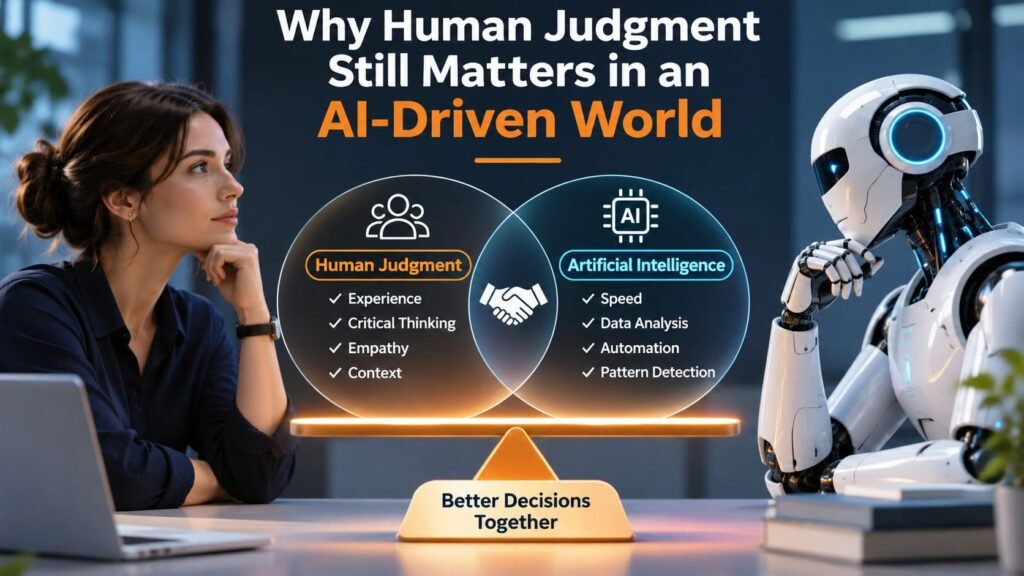
It is easy to think of artificial intelligence and human intelligence as competing forces. In reality, they can be much more effective when used together.
AI is particularly useful for handling repetitive tasks, organising information, identifying patterns, and processing large datasets. These capabilities allow professionals to spend less time on routine work.
Humans, meanwhile, bring experience, judgment, communication, creativity, and the ability to understand complex situations.
For example, a research team can use AI to analyse thousands of customer responses. This makes it easier to identify common opinions and emerging trends. But understanding what those findings mean for customers and deciding how the organisation should respond still requires human involvement.
The same approach works across different industries.
Rather than asking whether AI can replace human intelligence, businesses should focus on how both can complement each other.
The goal should be to make people more capable with technology, not less involved in the decisions that matter.
Why Human Judgment Will Become Even More Important
As AI tools become more accessible, knowing how to use them will become an increasingly valuable professional skill. But knowing when to question their results will be just as important.
The future workplace will need people who can understand technology without depending on it for every answer.
Professionals will need to develop skills such as critical thinking, communication, problem-solving, adaptability, and ethical decision-making. These abilities help people work with AI while remaining aware of its limitations.
Businesses also have a responsibility to create the right balance. Employees should be encouraged to use AI where it adds value, but important decisions should have appropriate human review and accountability.
Technology can improve the way work gets done. Human judgment helps ensure that the work is meaningful, accurate, and responsible.
Conclusion
Artificial Intelligence is not going away, and there is no reason why it should. It has opened new possibilities for businesses, researchers, and individuals by making information easier to access and complex tasks easier to manage.
But progress should not be measured only by how much work technology can complete.
It should also be measured by the quality of the decisions we make.
A machine can analyse information, recognise patterns, and recommend an action. But understanding the people involved, considering the consequences, and deciding what is right for a particular situation requires thoughtful judgment.
Perhaps the real question is not whether humans can compete with AI. It is whether we can use AI without losing the ability to think for ourselves.
The future will not simply belong to those who use the most advanced technology. It will belong to those who know how to combine technology with experience, understanding, and sound human judgment.
Frequently Asked Questions
1. Why is human judgment important in an AI-driven world?
Human judgment helps people understand complex situations, evaluate different perspectives, recognise ethical concerns, and make thoughtful decisions. AI can process information quickly, but human experience and critical thinking provide deeper understanding.
2. Can artificial intelligence completely replace human intelligence?
No, AI cannot completely replace human intelligence. Although it can automate tasks and analyse large amounts of data, human creativity, empathy, problem-solving, and practical experience remain essential.
3. What are the limitations of AI in decision-making?
AI may generate inaccurate results, misunderstand context, or depend on incomplete information. It can also struggle with ethical concerns and unexpected situations, making human review important for reliable decisions.
4. How can businesses combine AI with human judgment?
Businesses can use AI for automation, data analysis, and repetitive tasks while allowing professionals to interpret findings, evaluate risks, understand customer needs, and make important decisions.