
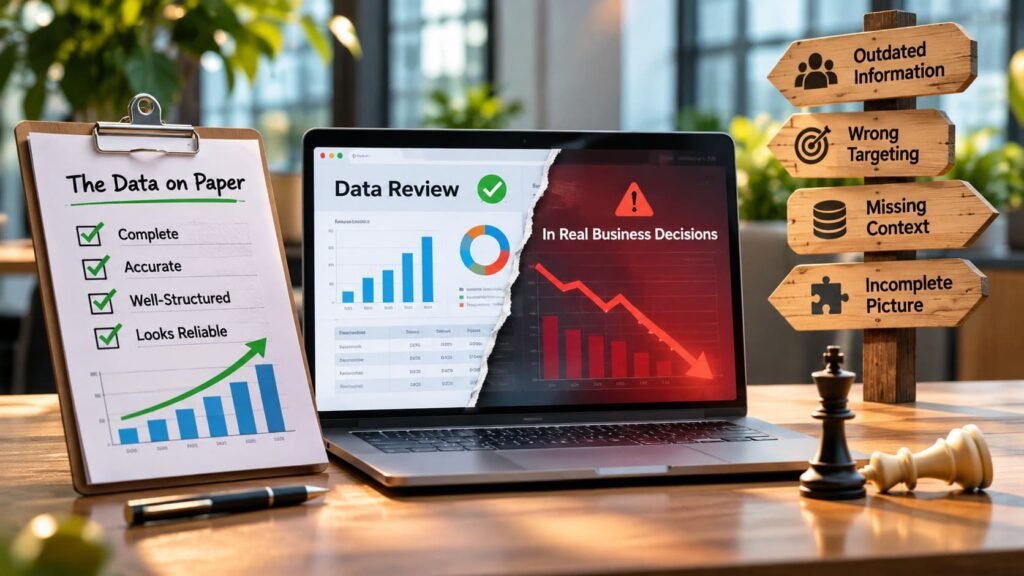
Businesses today collect more information than ever before. From customer behaviour and sales performance to market trends and operational reports, data has become an important part of everyday decision-making. Many organisations depend on dashboards, spreadsheets, analytics reports, and performance metrics to understand what is happening within their business.
But there is something businesses often overlook: data that looks accurate in a report does not always reflect what is actually happening in the real world.
A sales report might show steady growth, while the sales team struggles to convert interested prospects into customers. A customer satisfaction score may look impressive, but customer complaints continue to increase. Similarly, a marketing campaign may generate thousands of clicks without bringing meaningful business opportunities.
So, where does the problem begin?
The issue is not always incorrect data. Sometimes, the information itself is accurate, but the way it is collected, interpreted, or applied does not match real business situations.
Understanding this difference is essential for organisations that want to make better decisions and avoid relying on numbers that tell only part of the story.
1. Accurate Data Does Not Always Mean Useful Information
One of the biggest mistakes businesses make is assuming that accurate information automatically leads to better decisions.
Accuracy is important, but usefulness depends on context.
For example, imagine a company reviewing its monthly marketing performance. The report shows that website traffic increased by 40% compared to the previous month. At first glance, this looks like a successful campaign.
However, a closer examination reveals that most visitors came from locations outside the company’s target market. The increase in traffic did not generate additional enquiries or qualified leads.
The numbers were correct, but the conclusion was misleading.
This happens because businesses sometimes focus more on what can be measured than on what actually matters. Data should not simply describe activity; it should help explain whether that activity is contributing to business objectives.
2. Business Conditions Change Faster Than Reports
Another reason data fails in practical decision-making is that business environments are constantly changing.
Customer expectations shift, competitors introduce new strategies, market demand changes, and economic conditions influence purchasing behaviour. However, many organisations continue making decisions using reports that reflect situations from weeks or months earlier.
Consider a retail business that notices strong demand for a particular product during the previous quarter. Based on historical sales figures, the management decides to increase inventory.
Unfortunately, customer preferences have already shifted towards a different product.
The earlier report was not necessarily wrong. It simply no longer represented the current market situation.
This is why businesses need to understand when information was collected and whether it still reflects present conditions. Historical data can help identify patterns, but it should not be treated as a guarantee of future performance.
3. Numbers Cannot Always Explain Human Behaviour
Data is excellent at identifying patterns, but understanding the reasons behind those patterns requires deeper investigation.
Customers do not always behave according to what reports suggest. Their decisions can be influenced by personal preferences, financial situations, changing priorities, trust, convenience, and experiences with a brand.
For example, an online business might notice that many customers abandon their shopping carts before completing a purchase.
The analytics dashboard identifies the problem, but it does not necessarily explain why customers are leaving.
Possible reasons include unexpected delivery charges, complicated checkout steps, limited payment options, or concerns about payment security.
If management focuses only on the abandonment percentage, it may miss the actual reason behind the issue.
Combining numerical information with customer feedback, surveys, and behavioural observations can provide a much clearer understanding of what is happening.
4. Poor Data Context Can Lead to the Wrong Conclusions
Data becomes meaningful when it is understood in the right context.
A number viewed independently can create a completely different impression from the same number examined alongside other business information.
For instance, a company might notice that its customer acquisition cost has increased over the last three months. Management could immediately assume that marketing performance is declining.
However, the increase might be connected to a new strategy targeting larger businesses with higher contract values.
In this situation, the higher acquisition cost may be reasonable if the new customers generate greater long-term revenue.
Without considering factors such as customer lifetime value, conversion rates, sales cycles, and revenue contribution, management could make unnecessary changes to an otherwise successful strategy.
Before drawing conclusions, businesses should examine what the numbers represent and what other factors may influence them.
5. Different Departments Often Interpret the Same Data Differently
In many organisations, different departments work with the same information but have different priorities.
The marketing team may consider website enquiries a sign of campaign success. The sales team may judge performance based on how many enquiries become actual customers. Meanwhile, senior management may focus on revenue and profitability.
All three departments may be reviewing accurate information, yet their conclusions can be completely different.
This creates confusion when teams operate without shared definitions, reporting standards, and business objectives.
For example, if marketing considers every form submission a qualified lead while sales accepts only prospects with a clear requirement and purchasing intent, the two departments will report different results.
The solution is not simply to collect more information. Organisations need to establish common performance definitions and ensure that teams understand how their individual metrics contribute to wider business goals.
6. Overdependence on Dashboards Can Hide Important Problems
Dashboards make business information easier to access. They allow managers to monitor performance, compare results, and identify unusual changes without reviewing multiple reports.
However, dashboards also have limitations.
When organisations depend too heavily on visual indicators, they may overlook important details that are not included in the reporting system.
A dashboard might show that customer retention remains stable. But it may not reveal that long-term customers are becoming less engaged, raising more support requests, or reducing their purchases.
Similarly, an employee productivity dashboard might show that tasks are being completed quickly without reflecting the quality of the work.
Business dashboards should support investigation, not replace it.
Managers need to look beyond charts and percentages, ask meaningful questions, and understand the operational situations behind the reported results.
7. Using Outdated or Incomplete Data Creates Hidden Risks
Even a well-designed business strategy can fail when it is based on incomplete information.
Some organisations continue using old customer databases, outdated market research, incomplete sales records, or information collected from limited sources.
These gaps can affect decisions across different departments.
For example, a company planning to expand into a new region may rely on an old market research report. The report might indicate strong customer demand, but new competitors, changing customer preferences, and pricing differences could have significantly altered the opportunity.
When important information is missing, businesses may unknowingly make assumptions instead of informed decisions.
Regular data reviews, updated records, and information from multiple reliable sources can reduce these risks.
The goal is not to collect every possible data point. It is to ensure that the information being used is relevant, sufficiently complete, and suitable for the decision being made.
8. How Businesses Can Turn Data Into Better Decisions
The real value of data comes from how effectively an organisation uses it. Instead of treating reports as final answers, businesses should build a decision-making process that combines analytical insights with practical understanding.
Here are some useful approaches:
Start With the Business Question
Before reviewing reports, identify the actual problem that needs to be solved. Whether the objective is improving customer retention, increasing revenue, or reducing operational costs, the data should directly support that objective.
Check the Source and Freshness of Information
Understand where the information comes from, how frequently it is updated, and whether it accurately represents current business conditions.
Look Beyond Individual Metrics
Avoid making important decisions using a single number. Compare related indicators to understand the wider situation and identify possible causes.
Combine Data With Real-World Feedback
Customer conversations, employee observations, market research, and operational feedback can reveal details that numerical reports may overlook.
Encourage Collaboration Between Teams
Different departments bring different perspectives. Sharing information and agreeing on common performance indicators can help organisations reach more balanced conclusions.
Review the Results After Taking Action
A decision should not be considered successful simply because it was supported by a report. Businesses should monitor the outcome, compare it with expectations, and adjust their approach when necessary.
Conclusion
Data has become one of the most valuable resources for modern businesses, but having access to information does not automatically make an organisation better at making decisions.
A report can be accurate, a dashboard can look impressive, and performance figures can appear positive while important business problems remain hidden.
The difference lies in how organisations interpret information and connect it with real-world situations.
Businesses need to move beyond simply asking what the numbers show. They should also ask why those numbers look the way they do, what they might be missing, and whether the conclusions make sense in the current business environment.
Ultimately, successful decision-making is not about collecting the largest amount of data or creating the most detailed reports. It is about understanding the right information, questioning assumptions, and using evidence in a way that reflects actual business needs.
Frequently Asked Questions
1. Why can accurate data lead to poor decisions?
Because data without proper context can create misleading conclusions.
2. How does outdated data affect businesses?
It can lead to incorrect assumptions and ineffective business strategies.
3. Why is data quality important?
It helps businesses make reliable and informed decisions.
4. How can businesses improve data-driven decisions?
By combining reliable data with customer feedback and market insights.