
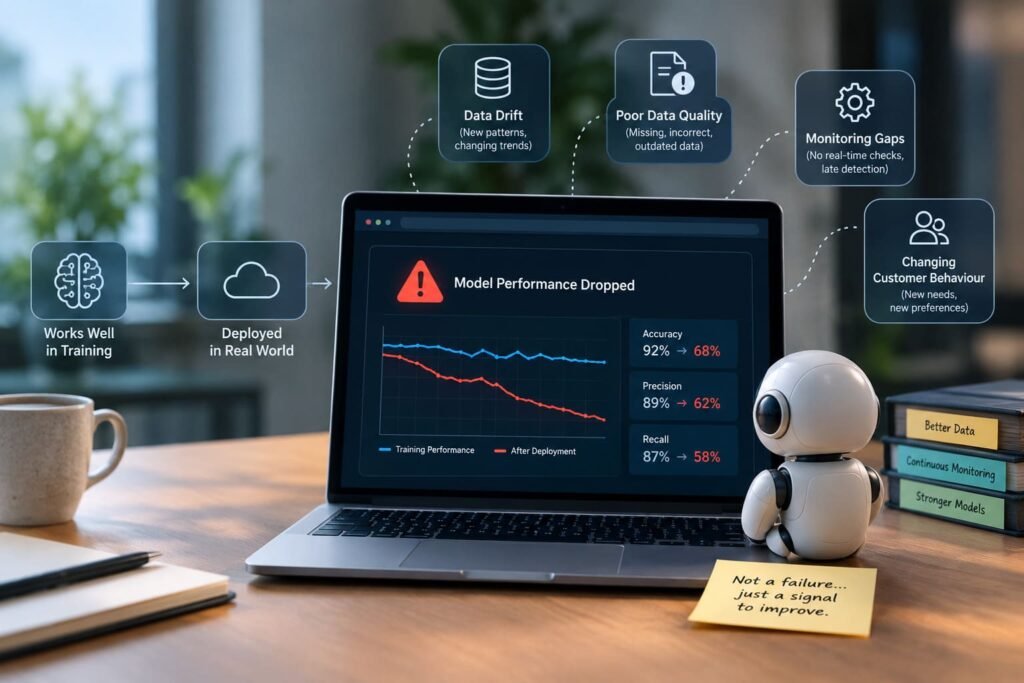
Machine learning has become an important part of modern businesses. From predicting customer behaviour to detecting fraud and improving business operations, organisations are increasingly relying on machine learning models to make better decisions.
During development, these models often deliver impressive results. They are trained using historical data, tested against different scenarios, and improved until their predictions reach an acceptable level of accuracy. However, the real challenge often begins after deployment.
A machine learning model that performs successfully in a testing environment may produce unexpected results when exposed to real-world data. Predictions may become less accurate, processing times may increase, or the model may struggle to recognise patterns that were not present during training.
This does not necessarily mean that the algorithm is poorly designed. In many situations, the problem comes from changing data, differences in operating environments, or a lack of continuous monitoring.
Understanding why these failures happen is essential for businesses that want to make machine learning a dependable part of their operations.
1. Training Data Cannot Always Represent Real-World Conditions
One of the most common reasons machine learning models fail after deployment is the difference between training data and real-world information.
During development, models learn patterns from historical datasets. These datasets help algorithms understand relationships between different variables and generate predictions. However, historical information does not always represent future conditions accurately.
For example, an online shopping company may develop a recommendation model using customers’ previous purchasing activities. During testing, the model successfully identifies products that customers are likely to purchase.
After deployment, the company introduces new product categories, changes its pricing strategy, and attracts a different customer audience. The model may struggle because its original training data does not fully represent these changes.
This situation highlights an important limitation of machine learning: past patterns cannot always predict future behaviour.
Businesses should regularly review whether their training datasets still reflect the conditions in which their models operate.
2. Data Drift Can Gradually Affect Prediction Accuracy
Data drift is another important challenge that can reduce machine learning performance after deployment.
It occurs when the characteristics or statistical distribution of incoming production data change compared with the information used during model training.
Consider a financial organisation that uses machine learning to identify unusual transactions. Initially, the model learns from transaction amounts, customer activities, and payment patterns.
Over time, customers begin using different payment methods, transaction volumes increase, and spending habits change. The incoming information gradually becomes different from the original training data.
Although the model continues generating predictions, its accuracy may decline because the patterns it previously learned are no longer equally relevant.
The difficult part is that data drift does not always cause an immediate failure. A model can continue operating normally while producing increasingly unreliable results.
Monitoring incoming data and identifying unusual changes can help organisations recognise this problem before it affects important business decisions.
3. Changing Customer Behaviour Makes Predictions Less Reliable
Customer preferences and purchasing decisions change constantly. New technologies, market competition, economic conditions, and changing expectations all influence how people interact with businesses.
Machine learning models trained on older customer behaviour may not always understand these changes.
For example, an e-commerce platform might use a recommendation system to suggest products based on customers’ previous searches and purchases.
Initially, the recommendations may be relevant. However, when customer interests change, the system might continue suggesting products based on outdated preferences.
This challenge is closely associated with concept drift.
Concept drift occurs when the relationship between input data and the outcome a model is trying to predict changes over time.
Unlike data drift, which focuses on changes in the input data distribution, concept drift focuses on changes in the underlying relationship between inputs and outcomes.
Businesses need to evaluate whether their models still understand current customer behaviour rather than assuming that previously learned patterns will remain relevant.
4. Poor Data Quality Creates Unreliable Predictions
Machine learning models depend on accurate and consistent information. Even a well-developed algorithm can produce poor results when the data entering the system contains errors.
During development, data scientists usually clean and prepare datasets before training a model. They remove duplicates, handle missing values, correct inconsistencies, and organise information into suitable formats.
However, production environments introduce new data quality challenges.
For example, a business may collect customer information from several platforms. One system may contain incomplete records, another may use different date formats, and a third may introduce duplicate customer details.
If this information enters a machine learning model without proper validation, the predictions may become unreliable.
Data quality problems are particularly difficult to identify when they develop gradually. Small inconsistencies can accumulate and eventually affect the overall performance of a model.
Maintaining automated validation processes and regularly checking incoming information can help prevent these issues.
5. Differences Between Testing and Production Environments
A model that works successfully during development may encounter unexpected problems when introduced into a live business environment.
Testing environments are generally controlled. They may use smaller datasets, predictable workloads, and specific software configurations.
Production environments are more complicated because they involve real users, continuous requests, changing workloads, and multiple system integrations.
For example, a machine learning model may process a few hundred records during testing without any difficulty. After deployment, the same model might need to process thousands of requests within a short period.
If the infrastructure does not have sufficient processing capacity, response times may increase or prediction requests may fail.
Differences in software libraries, data processing methods, and system configurations can also affect model performance.
This is why businesses should test machine learning systems under realistic operating conditions before making them available for everyday use.
6. Lack of Continuous Monitoring Allows Problems to Go Unnoticed
Deploying a machine learning model should not be considered the final stage of development.
Once a model becomes part of business operations, its performance needs regular evaluation.
Some organisations focus heavily on achieving high accuracy during testing but overlook the importance of monitoring the model after deployment.
For example, a company may use machine learning to forecast product demand. Initially, the predictions help the business maintain appropriate inventory levels.
Over time, customer demand changes, but the company continues relying on the same model without checking its performance. Eventually, inaccurate forecasts may result in excess inventory or product shortages.
Continuous monitoring helps organisations understand whether their models are still producing useful results.
Businesses should track prediction quality, error rates, incoming data changes, processing speed, and system availability to identify potential problems early.
7. Business Requirements Change Faster Than Machine Learning Models
Business environments rarely remain the same for long. Organisations introduce new products, expand into different markets, change internal processes, and adjust their strategies.
However, machine learning models may continue relying on the same historical information even when business requirements have changed.
Imagine a logistics company using a machine learning model to estimate delivery times. The model was trained using historical delivery routes and traffic information.
Later, the company expands into new locations and changes its delivery network. If the model is not updated to reflect these developments, its predictions may become less useful.
The original model may have been accurate when it was developed, but its assumptions may no longer match the company’s current operations.
Businesses should regularly review model performance whenever important operational changes occur.
8. Integration Problems Can Interrupt Model Performance
Machine learning models often depend on several connected systems, including databases, APIs, cloud platforms, and business applications.
These integrations allow models to receive information and share predictions with other systems.
However, problems with connected applications can interrupt the entire process.
For instance, a company may use a machine learning model to predict customer demand using information from its inventory management platform.
If the connection between these systems fails or data updates become delayed, the model may generate predictions using outdated inventory information.
Changes in API configurations, database structures, and software dependencies can also create unexpected problems.
Regular integration testing, error logging, and proper system validation can help organisations maintain reliable connections between machine learning models and other business applications.
9. Incorrect Model Evaluation Creates False Confidence
High accuracy during testing does not automatically guarantee successful performance after deployment.
A model may achieve impressive results on a testing dataset while struggling with real-world information.
For example, a fraud detection model might achieve 95% accuracy during evaluation. However, if the testing dataset does not properly represent actual transaction patterns, this result may not reflect its performance in production.
Businesses should also consider other evaluation measures, including precision, recall, false-positive rates, and prediction consistency.
The most suitable metrics depend on the purpose of the model. In fraud detection, missing suspicious transactions may create a different business risk than incorrectly flagging legitimate payments.
Evaluating models using realistic datasets and business-specific performance measures provides a more meaningful understanding of their reliability.
How Can Businesses Prevent Machine Learning Models From Failing After Deployment?
Preventing deployment failures requires continuous attention throughout the machine learning lifecycle. Organisations should not focus only on developing accurate algorithms; they must also establish processes to maintain their performance.
Some important practices include:
- Maintain data quality: Validate incoming information regularly and identify missing, duplicate, or inconsistent records.
- Monitor model performance: Track prediction quality, error rates, and response times after deployment.
- Identify data and concept drift: Compare production data with training information to recognise changing patterns.
- Test real-world conditions: Evaluate models under realistic workloads before introducing them into production.
- Establish retraining processes: Update models when new information or changing conditions affect their performance.
- Maintain version control: Track model versions, datasets, configurations, and deployment changes.
- Implement MLOps practices: Manage model development, deployment, monitoring, and maintenance through a structured operational process.
These practices help organisations identify problems earlier and maintain machine learning systems that remain useful as business conditions evolve.
Conclusion
Machine learning deployment is not simply about transferring a trained algorithm into a production environment. It is about ensuring that the model continues delivering accurate, relevant, and dependable results under changing real-world conditions.
Problems such as data drift, poor data quality, changing customer behaviour, infrastructure limitations, and insufficient monitoring can gradually reduce model performance.
For businesses, the important lesson is that machine learning requires continuous improvement. Models need to be evaluated, monitored, maintained, and updated as new information becomes available.
Organisations that treat deployment as an ongoing process rather than a one-time technical activity are better positioned to build reliable machine learning systems.
Ultimately, a successful machine learning model is not just one that performs well during testing. It is one that continues delivering meaningful results when businesses depend on it in the real world.
Frequently Asked Questions
1. Why do machine learning models fail after deployment?
Machine learning models may fail after deployment due to changing data patterns, poor data quality, outdated training datasets, and differences between testing and production environments.
2. What is data drift in machine learning?
Data drift occurs when real-world data changes compared with the original training data. These changes can affect prediction accuracy and reduce the reliability of machine learning models.
3. How can businesses prevent machine learning deployment failures?
Businesses can prevent deployment failures by monitoring model performance, maintaining data quality, detecting data drift, testing production environments, and regularly updating models.
4. Why is continuous monitoring important for machine learning models?
Continuous monitoring helps identify performance changes, unexpected predictions, data quality issues, and technical errors. It allows businesses to address problems before they affect important decisions.