In today’s digital business environment, information is generated from almost every activity. Sales teams record customer interactions, marketing teams collect campaign performance data, finance departments manage transactions, and customer support teams maintain service records. Each department depends on this information to make decisions and complete its daily responsibilities.
However, a problem often develops when these systems operate independently.
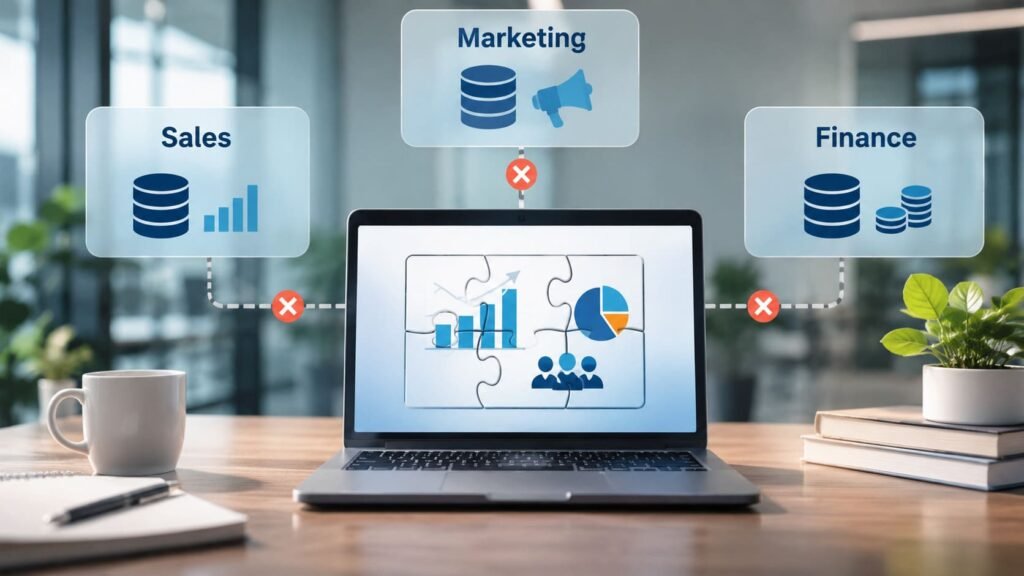
The information collected by one department may not be easily accessible to another. Customer details might exist in a CRM system, sales figures may be stored in spreadsheets, and service records could remain inside a separate support platform. Although each department has valuable information, the business may struggle to understand how everything connects.
This situation is known as a data silo.
Data silos can make it difficult for organizations to understand their customers, evaluate performance, identify operational problems, and make confident decisions. The challenge is not always a lack of data. Sometimes, businesses already have the information they need but cannot bring it together effectively.
Understanding how data silos develop and why they create problems is an important step toward building a more connected and informed business environment.
What Are Data Silos?
A data silo is a collection of information that remains isolated within a particular department, application, database, or business system.
The information may be stored digitally and regularly updated, but other teams cannot easily access, understand, or use it.
For example, a marketing team may maintain a database of campaign leads while the sales team uses a separate system to manage prospects. If these systems are not properly connected, sales representatives may not know which campaigns generated a particular lead or what information the marketing team collected before passing it along.
Both departments have useful data, but the organization cannot easily use that information together.
Data silos can develop because of different software platforms, departmental responsibilities, disconnected workflows, limited system integration, or inconsistent data-sharing practices.
They are not always created intentionally. In many cases, they develop gradually as businesses introduce new tools and processes to solve individual departmental problems.
How Data Silos Develop Within Businesses
Data silos often begin with a practical decision. A department adopts a software application because it meets a specific operational requirement. Another department later introduces a different application that serves its own needs.
Over time, these separate systems become part of the organization’s daily operations.
Several factors can contribute to this situation.
Different Departments Use Different Systems
Sales, marketing, finance, operations, and customer support may rely on different applications to manage their information.
When these systems cannot communicate effectively, data becomes separated across multiple platforms.
Even when employees have access to the same information, differences in structure or terminology can make it difficult to combine.
Limited Communication Between Teams
Departments may focus on their own targets and responsibilities without regularly sharing information with other teams.
For example, marketing may measure campaign engagement, while sales focuses on completed deals. If both departments do not share their findings, they may miss important connections between campaign activity and revenue outcomes.
Business Growth Creates More Data Sources
As businesses expand, they often introduce new tools, hire additional teams, and enter new markets.
Each new system can create another location where information is stored.
Without a clear approach to data management, the organization may find it increasingly difficult to maintain a connected view of its operations.
Data Ownership Is Not Clearly Defined
When responsibilities for maintaining and sharing information are unclear, departments may manage the same data differently.
One team may update customer details while another continues using older records. This can create confusion about which information is current and reliable.
Why Data Silos Prevent Businesses From Getting a Complete Picture
The biggest challenge with data silos is that they limit the ability to connect information from different parts of the business.
A company may have detailed records of its sales, customer behaviour, marketing activities, and service performance. However, when these records remain separated, decision-makers may only see individual parts of a much larger situation.
1. They Make Customer Understanding More Difficult
Customers interact with businesses through several channels. They may visit a website, respond to an email campaign, speak with a sales representative, purchase a product, and later contact customer support.
Each interaction provides useful information about their needs and expectations.
When these interactions are stored in separate systems, employees may not have access to the customer’s complete history.
A sales representative might not know that a customer recently contacted support about a product issue. Similarly, the support team may not know about a recent purchase or an ongoing sales discussion.
This limited visibility can lead to repeated questions, inconsistent communication, and less relevant customer experiences.
Connecting customer information helps businesses understand interactions more clearly and respond with better context.
2. They Create Gaps in Business Reporting
Business reports are often prepared using information collected from different departments.
When data sources remain disconnected, reports may show only a partial view of performance.
For example, a marketing report may indicate that a campaign generated a large number of leads. However, the sales team may have received very few qualified opportunities from that campaign.
If marketing and sales data are not connected, management may struggle to understand why the campaign produced limited business results.
A more connected reporting process can help organizations evaluate the relationship between campaign activity, sales opportunities, customer conversions, and revenue.
3. They Slow Down Decision-Making
Business decisions frequently require information from multiple sources.
A manager evaluating a new market opportunity may need sales history, customer demand, operational capacity, and financial information.
If each department maintains separate records, collecting and preparing the required information can take additional time.
Employees may need to request reports, manually combine spreadsheets, or verify information with different teams before reaching a conclusion.
These delays can make it harder for businesses to respond quickly when market conditions or customer expectations change.
4. They Increase the Risk of Inconsistent Information
Different departments may maintain separate versions of the same business information.
For instance, a customer’s company name, contact details, account status, or transaction history may be recorded differently across multiple systems.
One department might update a record while another continues using an older version.
As a result, employees may disagree about which information is correct.
Data silos do not automatically make every record inaccurate, but they can make consistency more difficult to maintain, especially when systems lack clear synchronization and data ownership.
5. They Make Business Trends Harder to Identify
Important business patterns often become visible only when information from different sources is examined together.
A company might notice that customer complaints increase after a particular product update. Another organization may discover that certain marketing campaigns attract customers with higher long-term value.
These insights may remain hidden when operational, customer, and financial data are separated.
Connecting relevant information allows analysts to investigate relationships that would otherwise be difficult to identify.
It also helps businesses ask better questions about their performance instead of relying only on individual departmental reports.
6. They Create Unnecessary Manual Work
When business systems do not share information automatically, employees often find ways to fill the gaps manually.
They may export spreadsheets, copy records between applications, prepare separate reports, or repeatedly request information from other teams.
These activities consume time that could be spent on more valuable work.
Manual data movement can also introduce mistakes, particularly when employees work with large datasets or update information in multiple locations.
Reducing unnecessary manual processes can improve efficiency and make information easier to maintain.
A Practical Example of Data Silos in Business
Consider a company that generates leads through digital marketing campaigns.
The marketing team uses one platform to track website enquiries and campaign engagement. The sales team maintains its own CRM records, while the customer support team uses a separate application to manage service requests.
Each department has useful information.
Marketing knows which campaigns attracted visitors. Sales knows which prospects became customers. Customer support understands the problems customers experience after purchasing.
However, these insights remain separated.
Marketing may continue promoting a product to customers who have already purchased it. Sales representatives may contact prospects who recently requested assistance. Management may struggle to determine whether a campaign generated valuable customers or simply increased the number of enquiries.
When these systems are connected appropriately, the business can develop a clearer understanding of the customer journey.
Marketing can evaluate campaign outcomes beyond initial enquiries. Sales can access relevant prospect history. Customer support can understand previous interactions more easily.
The value comes from connecting information that already exists across the organization.
How Businesses Can Reduce Data Silos
Removing data silos does not necessarily mean replacing every existing application or storing all information in one database.
The goal is to make relevant information accessible, consistent, and useful across the organization while maintaining appropriate security and ownership.
Identify Where Business Data Is Stored
Businesses should begin by understanding which systems, applications, spreadsheets, and databases contain important information.
This process helps identify disconnected data sources, overlapping records, and areas where information is difficult to access.
A clear understanding of the existing data environment makes it easier to decide which systems need to be connected.
Improve Data Integration
Data integration allows information from different sources to be combined or shared in a controlled manner.
Businesses may use APIs, integration platforms, data pipelines, or other suitable technologies to connect their systems.
The appropriate approach depends on the organization’s technical environment, data volume, security requirements, and business objectives.
Establish Clear Data Ownership
Every important dataset should have a clear owner responsible for its quality, maintenance, and appropriate use.
Data ownership helps establish who can update information, who is responsible for resolving inconsistencies, and how changes should be communicated to other teams.
This reduces confusion and supports more consistent information management.
Create Shared Reporting Standards
Departments should use consistent definitions for important business metrics.
For example, marketing and sales should agree on what qualifies as a lead, a qualified opportunity, and a converted customer.
Without shared definitions, even connected systems can produce reports that are difficult to compare.
Standardized reporting helps organizations evaluate performance using a common understanding of business results.
Encourage Collaboration Between Departments
Technology alone cannot solve every data silo problem.
Employees also need clear processes for sharing information and communicating important findings.
Regular collaboration between departments can help identify missing information, improve reporting practices, and ensure that data is being used effectively.
The Role of Connected Data in Better Business Decisions
Connected data gives organizations a stronger foundation for understanding how different business activities influence one another.
When relevant information is available across departments, decision-makers can evaluate performance with greater context.
For example, businesses can connect marketing activity with sales outcomes, examine customer service trends alongside product performance, and compare operational efficiency with financial results.
This does not guarantee that every decision will be correct. Data still needs to be accurate, relevant, and interpreted carefully.
However, a connected data environment makes it easier to investigate business questions using information from multiple sources rather than relying on isolated reports.
It also supports more effective use of analytics tools, business intelligence platforms, and artificial intelligence systems that depend on suitable data from different parts of an organization.
Conclusion
Data silos are not simply a technology problem. They reflect the way information is collected, managed, shared, and used across a business.
When departments operate with disconnected data, organizations may struggle to understand customers, evaluate performance, identify trends, and make timely decisions.
The solution is not always to introduce more software. Businesses first need to understand where their information exists and how different teams can use it together.
By improving data integration, establishing clear ownership, creating shared reporting standards, and encouraging collaboration, organizations can reduce information gaps and develop a more complete view of their operations.
In a business environment where decisions increasingly depend on information, connecting data across departments can help companies move beyond isolated insights and build a clearer understanding of what is happening throughout the organization.
Frequently Asked Questions
1. What are data silos in business?
Data silos are collections of information stored in separate departments, applications, or systems that are not easily accessible or shared across an organization.
2. Why are data silos a problem for businesses?
Data silos can limit collaboration, create inconsistent information, slow down decision-making, and prevent businesses from understanding their overall performance.
3. How can businesses reduce data silos?
Businesses can reduce data silos by connecting relevant systems, improving data integration, establishing clear data ownership, and encouraging information sharing between departments.
4. How does data integration help overcome data silos?
Data integration brings information from different sources together, helping organizations access connected data, improve reporting, identify patterns, and make more informed decisions.