Every day, businesses generate large amounts of data through customer interactions, online transactions, website activity, sales records, and digital platforms. However, collecting data is only the first step. The real value comes from understanding what that information reveals and how it can help organizations prepare for the future.
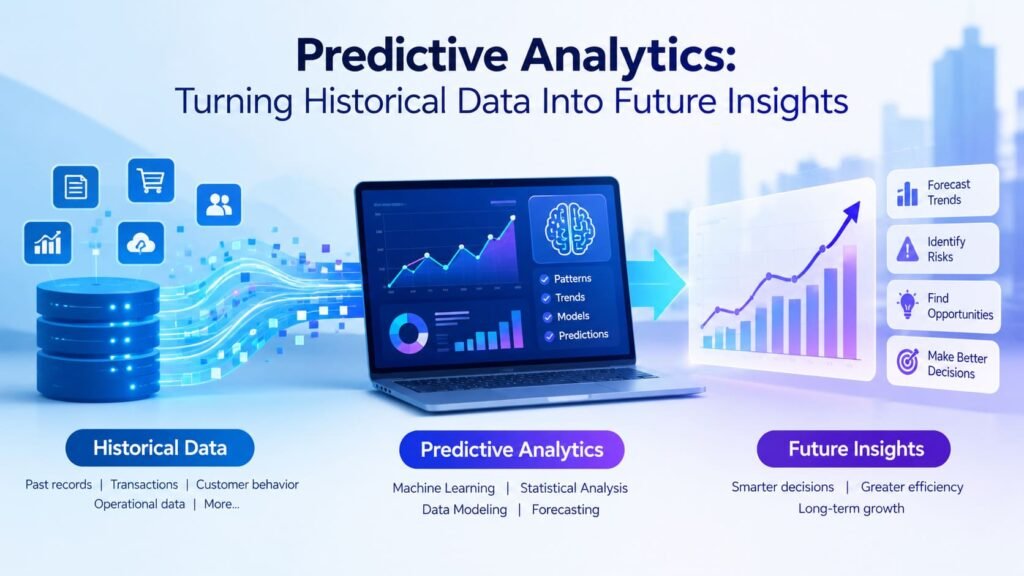
Predictive analytics helps businesses identify patterns in historical data and estimate what may happen next. By combining statistical techniques, machine learning, and data analysis, organizations can make more informed decisions instead of relying entirely on assumptions.
As data continues to grow across industries, predictive analytics is becoming an important part of modern data-driven decision-making.
What Is Predictive Analytics?
Predictive analytics is a branch of data analytics that uses historical and current information to estimate future outcomes. It examines patterns, relationships, and trends within datasets to identify possible opportunities and risks.
For example, a retail company can analyze previous sales, seasonal demand, and customer purchasing behavior to estimate which products may sell well next month. Similarly, a financial institution can study transaction patterns to identify activity that may require further investigation.
Predictive analytics does not guarantee an exact result. Instead, it provides estimates based on available information, statistical methods, and assumptions about how patterns may continue.
How Predictive Analytics Turns Data Into Insights
Predictive analytics involves several connected steps. Each stage helps transform raw information into useful predictions.
1. Collecting Historical Data
The process begins with gathering relevant information from sources such as databases, customer records, transaction systems, website analytics, and operational platforms.
The quality and relevance of this information directly affect the usefulness of the final predictions. Incomplete, outdated, or inconsistent data can produce misleading results.
2. Preparing and Cleaning Data
Before analysis begins, datasets need to be checked for missing values, duplicate records, inconsistent formats, and errors.
Data preparation helps ensure that analytical models work with reliable information. It may also involve combining data from different systems to create a more complete picture of a business problem.
3. Identifying Patterns and Relationships
Once the data is prepared, analysts explore trends and relationships that may influence future outcomes.
For example, historical records might reveal that product demand increases during certain seasons or that equipment failures become more frequent after extended operating periods.
These patterns provide a foundation for building predictive models.
4. Building Predictive Models
Statistical methods and machine learning algorithms use historical examples to learn relationships between different variables.
Depending on the objective, a model may estimate future sales, predict customer churn, forecast inventory requirements, or identify the likelihood of a particular event.
The model must be tested against data it has not previously seen to determine whether its predictions are reliable.
5. Interpreting Predictions and Taking Action
Predictions become valuable when organizations understand how to use them.
A business might increase inventory before an expected rise in demand, investigate unusual transactions, or improve maintenance schedules based on equipment failure risks.
The goal is not simply to generate forecasts. It is to use those forecasts to support better decisions.
Common Techniques Used in Predictive Analytics
Different analytical techniques are suitable for different types of problems.
Regression Analysis
Regression analysis estimates relationships between variables and helps predict numerical values. Businesses can use it to estimate sales revenue, operating costs, product demand, or other measurable outcomes.
Time Series Forecasting
Time series forecasting examines data recorded over time to identify trends, recurring patterns, and seasonal changes. It is useful for demand planning, energy consumption forecasting, and financial analysis.
Classification Models
Classification models estimate which category an observation is likely to belong to. Examples include identifying potentially fraudulent transactions, predicting customer churn risk, and classifying equipment conditions.
Machine Learning
Machine learning enables models to identify patterns from historical examples. Depending on the dataset and business objective, techniques such as decision trees, random forests, and gradient boosting can support predictive tasks.
Selecting the right method depends on the available data, prediction objective, complexity of the problem, and acceptable level of error.
Real-World Applications of Predictive Analytics
Predictive analytics is useful across industries because many organizations need to anticipate changes before they occur.
Retail and E-Commerce
Retailers can analyze historical purchases, seasonal trends, promotions, and product availability to estimate future demand. These insights help improve inventory planning and reduce the risk of overstocking or running out of popular products.
Healthcare
Healthcare organizations can use historical patient information and operational data to estimate patient demand, support resource planning, and identify potential health risks. These applications require appropriate privacy safeguards, careful validation, and professional oversight.
Banking and Finance
Financial institutions can use predictive models to estimate credit risk, detect unusual transaction patterns, and forecast financial trends. Predictions can help prioritize further investigation, but they should not automatically be treated as proof of fraud or misconduct.
Manufacturing
Manufacturers can analyze equipment sensor readings, maintenance logs, and production records to estimate when machinery may require attention. Predictive maintenance can help teams plan interventions before a potential failure causes costly downtime.
Supply Chain Management
Supply chain teams can combine historical orders, delivery records, supplier performance, and demand trends to anticipate shortages or delays. Better forecasts support purchasing decisions, warehouse planning, and distribution management.
Benefits of Predictive Analytics
When implemented carefully, predictive analytics offers several practical advantages.
- Better decision-making: Decisions can be supported by data-based estimates rather than intuition alone.
- Early risk identification: Organizations can recognize warning signs and investigate potential problems sooner.
- Improved resource planning: Demand forecasts help teams allocate inventory, staff, budgets, and equipment more effectively.
- Greater operational efficiency: Predictions can reveal where processes may need attention before problems become more expensive.
- Customer insights: Historical behavior can help organizations understand changing needs and identify customers who may require additional support.
These benefits depend on model quality, data reliability, and how effectively teams translate predictions into action.
Challenges in Predictive Analytics
Despite its advantages, predictive analytics comes with challenges that organizations must address.
Poor Data Quality
Missing, inaccurate, or inconsistent records can weaken model performance. Organizations need reliable data collection, validation, and maintenance processes.
Changing Patterns
Customer preferences, market conditions, regulations, and operational environments can change over time. A model that performed well previously may become less accurate when these patterns shift.
Privacy and Data Security
Predictive models may use sensitive customer, financial, or operational information. Organizations should apply appropriate access controls, data protection measures, and privacy practices.
Model Bias and Reliability
Historical data may reflect existing inequalities or past mistakes. Models can reproduce these patterns if they are not evaluated carefully. Regular testing, monitoring, and human oversight help reduce this risk.
Difficulty Interpreting Results
Some models produce predictions that are difficult to explain. Businesses need to understand the factors influencing important predictions, particularly when decisions affect customers, employees, or financial outcomes.
Best Practices for Effective Predictive Analytics
Organizations can improve their predictive analytics initiatives by following a structured approach:
- Define a clear objective: Identify the business question the model needs to answer.
- Use relevant data: Select reliable information that reflects the problem being investigated.
- Choose appropriate techniques: Match the analytical method to the prediction task rather than selecting a model simply because it is popular.
- Test model performance: Evaluate predictions against unseen data and use suitable performance measures.
- Monitor results continuously: Track changes in accuracy and update models when underlying patterns shift.
- Combine data with human judgment: Use predictions as decision support while considering business context, uncertainty, and potential consequences.
Starting with a focused, measurable problem often makes it easier to evaluate whether predictive analytics is delivering meaningful value.
The Future of Predictive Analytics
Advances in artificial intelligence, machine learning, cloud computing, and data infrastructure are expanding the ways organizations can use predictive analytics.
Businesses can increasingly process larger datasets, combine information from multiple sources, and update forecasts as new data becomes available. Automated monitoring can also help teams detect changes in model performance and identify when further investigation is needed.
However, more advanced technology does not automatically produce better predictions. Reliable data, appropriate evaluation, transparent processes, and responsible use remain essential.
The organizations most likely to benefit will be those that connect predictive insights with clear business objectives and continuously learn from actual outcomes.
Conclusion
Predictive analytics helps organizations turn historical data into informed estimates about future events. From forecasting demand and identifying risks to improving maintenance and resource planning, it provides a practical way to prepare for possible changes.
Its success depends on more than sophisticated algorithms. Reliable data, suitable analytical methods, regular testing, and thoughtful decision-making all play important roles.
By building these foundations, organizations can use predictive analytics to understand emerging patterns, reduce uncertainty, and make better-informed decisions in an increasingly data-driven world.
Frequently Asked Questions
1. What is predictive analytics?
Predictive analytics uses historical data, statistical techniques, and machine learning to estimate future outcomes and help organizations make informed decisions.
2. How does predictive analytics work?
It involves collecting relevant data, cleaning datasets, identifying patterns, building predictive models, and evaluating results to forecast possible future events.
3. What are the common applications of predictive analytics?
Predictive analytics is used for sales forecasting, customer churn prediction, fraud detection, inventory planning, risk assessment, and predictive maintenance.
4. What are the main challenges of predictive analytics?
Common challenges include poor data quality, privacy concerns, biased models, changing data patterns, and inaccurate predictions. Regular testing helps improve reliability.