
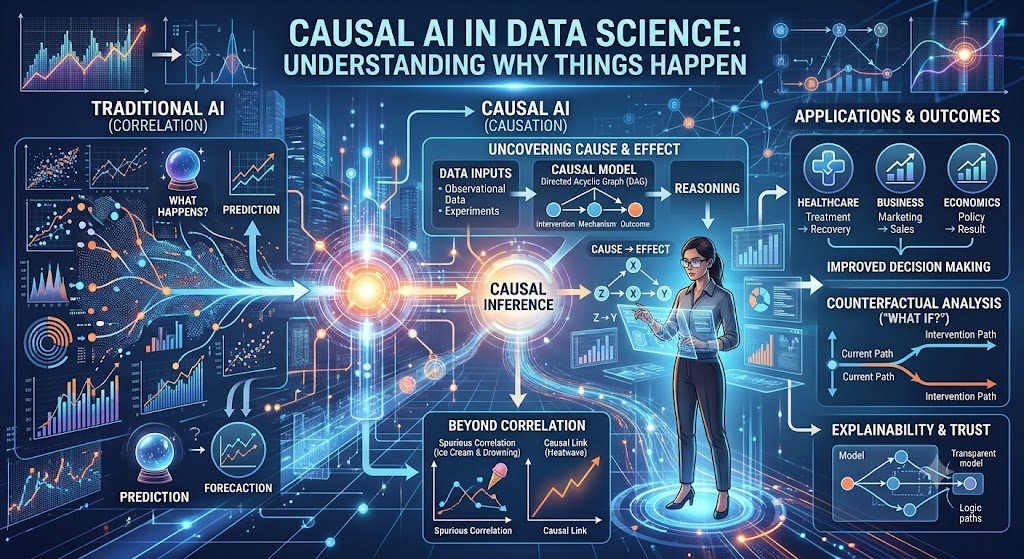
Data science has become an important part of modern decision-making. Businesses, researchers, and organizations use data to identify trends, predict future outcomes, and understand changing patterns. However, predicting what might happen does not always explain why it happens. This is where Causal AI in Data Science becomes valuable.
Causal AI focuses on understanding cause-and-effect relationships within data. Instead of simply identifying patterns, it helps data scientists investigate which factors may influence an outcome and what could happen if those factors changed. This approach can support more informed decisions across industries, from healthcare and finance to manufacturing and digital services.
For example, a company might notice that sales increase during a particular month. Traditional data analysis can identify this pattern, but causal analysis can investigate whether the increase resulted from a marketing campaign, seasonal demand, a price change, or another factor.
By looking beyond surface-level patterns, causal AI offers a deeper way to understand data and use it to solve practical problems.
What Is Causal AI in Data Science?
Causal AI is an approach that combines artificial intelligence, statistical methods, and causal reasoning to investigate relationships between events and outcomes. It aims to help systems distinguish between variables that occur together and factors that actually contribute to a particular result.
Consider an online store that notices customers who receive promotional emails tend to make more purchases. This relationship alone does not prove that the emails caused the increase. Customers who already have a strong interest in the products may be more likely to open promotional messages and buy something.
Causal analysis helps researchers examine these alternative explanations and estimate the impact of the promotion under appropriate assumptions.
According to research on causality in AI, understanding cause and effect can improve the reliability and interpretability of machine learning systems. However, reliable conclusions depend on the quality of the data, the assumptions used, and the methods applied.
Why Is Causal AI Important in Data Science?
Traditional data analysis is useful for finding trends and making predictions. However, organizations often need more than a forecast. They want to know which actions could improve a result.
Causal AI helps address this need in several ways.
1. Understanding the Root Cause of Problems
When a business experiences declining sales, a predictive model might identify the likelihood of further decline. Causal analysis can help investigate possible contributing factors, such as product availability, pricing, customer experience, or changes in demand.
Understanding these factors gives decision-makers a stronger starting point for choosing corrective actions.
2. Supporting Better Decisions
Organizations regularly make decisions about budgets, staffing, production, and customer engagement. Causal methods can help estimate how different actions may affect outcomes.
For example, a manufacturer may investigate whether changing a maintenance schedule reduces equipment downtime. The goal is to understand the effect of the change rather than simply observe that downtime and maintenance occur together.
3. Improving Machine Learning Reliability
Machine learning models sometimes learn patterns that appear useful in historical data but do not remain reliable in new situations. Causal reasoning can help researchers investigate whether a model depends on misleading associations.
This can be particularly important when environmental conditions, customer behavior, or operating processes change.
4. Evaluating the Impact of Actions
Causal analysis can help answer questions such as:
- Did a new pricing strategy increase revenue?
- Did a training program improve employee performance?
- Did a website redesign increase completed purchases?
- Did a new production process reduce defects?
The answers depend on the available evidence and the research design, but these questions illustrate why causal methods are useful for practical decision-making.
How Does Causal AI Work?
Causal AI does not rely on one universal technique. It uses different analytical methods to investigate possible cause-and-effect relationships.
Step 1: Define the Problem
The first step is to identify the question that needs to be answered. A clearly defined question helps determine which data, variables, and analytical methods are appropriate.
For example, a retailer might ask whether offering free delivery increases the number of completed orders.
Step 2: Collect and Prepare Data
Data scientists gather relevant information, which may include order histories, delivery charges, customer behavior, product prices, and promotional activity.
The data must be checked for missing values, inconsistent records, measurement errors, and other quality issues. Poor-quality data can lead to misleading conclusions.
Step 3: Identify Relevant Variables
Researchers identify the factor they want to investigate, the outcome they want to measure, and other variables that might influence both.
In the delivery example, the treatment could be free delivery, while the outcome could be completed purchases. Order value, customer type, and promotional periods might also matter.
Step 4: Build a Causal Model
A causal model represents the relationships researchers believe may exist between variables. Causal graphs can make these assumptions easier to examine and communicate.
Domain knowledge is important because data alone may not reveal every relevant relationship. A model should be checked against available evidence rather than accepted simply because an algorithm produces it.
Step 5: Estimate the Causal Effect
Researchers use suitable methods to estimate how an outcome changes when a factor is introduced or altered. Depending on the situation, they may use randomized experiments, observational-data methods, or other causal inference techniques.
A randomized experiment can offer strong evidence when it is practical and properly designed. Observational analysis may be necessary when experiments are too expensive, unethical, or difficult to conduct.
Step 6: Validate the Findings
Finally, analysts examine whether the results are consistent with the data, assumptions, and relevant domain knowledge. They should consider uncertainty, alternative explanations, and whether the findings apply to other populations or situations.
This validation helps prevent organizations from treating an uncertain relationship as a proven cause.
Causal AI vs. Traditional Machine Learning
Although causal AI and traditional machine learning can work together, they often address different questions.
| Aspect | Traditional Machine Learning | Causal AI |
|---|---|---|
| Main objective | Predict likely outcomes | Investigate cause-and-effect relationships |
| Typical question | What is likely to happen? | What may happen if we change something? |
| Approach | Learns patterns from data | Uses causal models, assumptions, and evidence |
| Common application | Demand forecasting | Estimating the effect of a pricing change |
| Main limitation | Predictions may rely on unstable patterns | Conclusions depend on assumptions and data quality |
These approaches are not competitors in every situation. Traditional machine learning can make accurate predictions, while causal methods can help investigate the effects of decisions. Combining them may provide a more complete understanding of a problem.
Real-World Applications of Causal AI
Healthcare and Medical Research
Healthcare researchers can use causal inference to investigate whether a treatment improves patient outcomes, while accounting for relevant differences between groups. These methods can support research and clinical decision-making, although they do not replace clinical expertise or appropriately designed medical studies.
Finance and Risk Analysis
Financial institutions can investigate factors associated with loan defaults, fraud, or changing customer behavior. Causal methods may help distinguish actionable risk factors from relationships that merely appear in historical records.
Manufacturing and Industrial Operations
Manufacturers can examine whether equipment settings, maintenance activities, or production conditions contribute to defects and downtime. These insights may help teams prioritize process improvements and test whether interventions produce measurable benefits.
Marketing and Customer Analytics
Marketing teams can use causal analysis to estimate the effect of advertising, discounts, email campaigns, and website changes. Rather than relying only on clicks or conversions, they can investigate whether an activity generated additional results that would not otherwise have occurred.
Supply Chain Management
Organizations can investigate how supplier delays, inventory policies, transportation changes, and demand fluctuations affect delivery performance. Understanding the underlying relationships can support better planning and more targeted operational changes.
Challenges and Limitations of Causal AI
Despite its potential, causal AI is not a shortcut to discovering the truth in every dataset. Several challenges need careful consideration.
Data quality: Missing, inaccurate, or biased data can distort causal estimates.
Hidden confounding factors: An unmeasured variable may influence both the suspected cause and the outcome, making the relationship difficult to interpret.
Incorrect assumptions: A causal model can produce misleading conclusions if its assumptions do not reflect the real situation.
Limited experimental evidence: Observational data can be useful, but it may not provide enough information to establish causality confidently.
Changing conditions: Relationships identified in one environment may not hold when customer behavior, technology, or operating conditions change.
Technical expertise: Causal inference requires statistical understanding, subject knowledge, and careful interpretation.
These limitations make validation essential. Causal AI should support informed reasoning rather than encourage automatic acceptance of model-generated explanations.
The Future of Causal AI in Data Science
As organizations collect more data and use increasingly sophisticated AI systems, the need to understand why outcomes occur is likely to remain important. Causal reasoning offers a way to complement predictive analytics with more structured investigation of cause and effect.
Future applications may combine causal inference with machine learning, simulation, and decision-support systems. Such combinations could help organizations evaluate alternative actions, study potential outcomes, and respond more thoughtfully to changing conditions.
However, progress will depend on better evaluation methods, reliable datasets, transparent assumptions, and meaningful human oversight. Strong causal conclusions require more than advanced algorithms; they require sound research practices.
Conclusion
Causal AI in data science helps shift the focus from identifying patterns to investigating why those patterns occur. By examining cause-and-effect relationships, data scientists can better evaluate interventions, explore root causes, and support decisions based on stronger evidence.
From healthcare research to manufacturing and marketing analytics, causal methods can help answer questions that ordinary prediction alone may not resolve. Their value is greatest when the analysis combines reliable data, domain knowledge, appropriate methods, and careful validation.
As data-driven decision-making continues to evolve, causal AI can become a useful part of the data science toolkit, helping organizations move beyond knowing what happened toward understanding what may have caused it.
Frequently Asked Questions
1. What Is Causal AI in Data Science?
Causal AI in data science uses statistical methods, artificial intelligence, and causal reasoning to understand how one factor influences another and why particular outcomes occur.
2. How Is Causal AI Different from Traditional AI?
Traditional AI often identifies patterns and predicts outcomes, while Causal AI investigates cause-and-effect relationships to help explain why outcomes happen and how changes may affect them.
3. Can Causal AI Work with Historical Data?
Yes, Causal AI can analyze historical data to investigate possible causal relationships. However, reliable findings depend on data quality, suitable analytical methods, and carefully examined assumptions.
4. Which Industries Can Benefit from Causal AI?
Healthcare, finance, manufacturing, marketing, and supply chain management can use causal analysis to evaluate decisions, investigate problems, and better understand factors that influence business outcomes.
5. Does Causal AI Always Identify the True Cause?
No, Causal AI cannot guarantee that every identified relationship represents the true cause. Hidden variables, incomplete data, and incorrect assumptions can affect the accuracy of its conclusions.