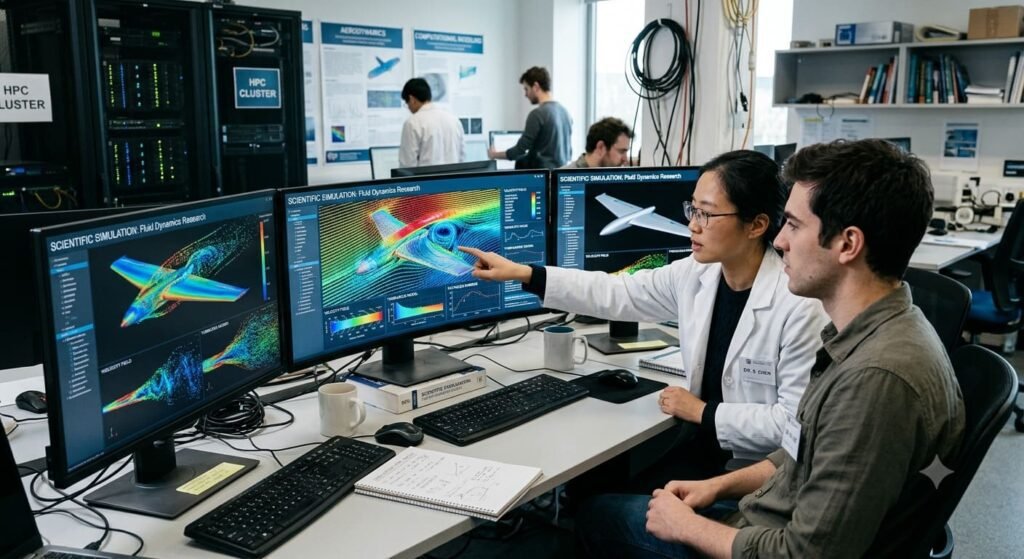
Scientific research often begins with a simple question: What would happen if we changed something? Finding the answer, however, is not always easy. Some experiments require expensive equipment, take years to complete, or involve conditions that are difficult or dangerous to recreate in a laboratory.
This is where scientific simulation becomes valuable. By using computer models, researchers can explore ideas, change different variables, and study possible outcomes before carrying out physical experiments.
From predicting weather patterns to understanding how new materials behave, scientific simulations are changing how researchers investigate the world. They provide a practical way to test assumptions, identify potential problems, and make better use of research time and resources.
What Is Scientific Simulation?
Scientific simulation is a computer-based method of representing a real-world process or system. It uses mathematical equations, scientific principles, algorithms, and data to estimate how something may behave under particular conditions.
Instead of building a physical model or performing an experiment immediately, researchers create a digital version of the system they want to study.
For example, a scientist investigating how heat moves through a new material can use simulation software to examine temperature changes under different conditions. The researcher can adjust the material’s properties, change the surrounding temperature, and compare the predicted results.
This makes it possible to explore multiple possibilities without producing a separate physical sample for every test.
However, a simulation is only as useful as the assumptions, data, and scientific methods behind it. Its results need to be evaluated carefully before researchers rely on them.
How Do Computer Simulations Work?
A scientific simulation follows a series of steps that turn a research question into results that can be examined.
1. Defining the Research Question
The process starts with a clear question. Researchers decide what they want to understand, which factors may influence the outcome, and what information they need to collect.
For example, a climate researcher might investigate how changing temperatures could influence rainfall patterns in a particular region.
2. Building a Computer Model
Researchers create a model that represents the important features of the system. Depending on the subject, it may use physical laws, chemical reactions, biological processes, statistical relationships, or information collected from previous experiments.
The model does not need to reproduce every detail of reality. It needs to represent the factors that matter to the research question.
3. Entering Data and Changing Variables
Next, researchers provide the model with the necessary starting conditions and input data. They can then adjust individual variables to investigate different scenarios.
A materials scientist, for instance, might change temperature, pressure, or the composition of a material to understand how these factors affect its performance.
4. Running the Simulation
The computer processes the model’s equations and instructions to estimate what may happen under the selected conditions. Complex simulations may require powerful computing systems because they involve large datasets or many interacting variables.
Researchers can repeat the process with different inputs to compare possible outcomes.
5. Analyzing and Validating the Results
Once the simulation finishes, researchers examine its output, identify patterns, and compare the predictions with available experimental measurements or observed data.
This step helps determine whether the model represents the real system accurately enough for its intended purpose. If the results differ significantly from reality, researchers may need to improve the model or reconsider its assumptions.
Why Do Researchers Use Scientific Simulation?
Scientific simulation offers several advantages, particularly when traditional experiments are difficult to perform.
Reducing Research Costs
Physical experiments can require specialized instruments, laboratory materials, prototypes, and trained personnel. Simulations allow researchers to investigate many initial possibilities digitally before investing in physical testing.
This can help research teams prioritize the experiments most likely to provide useful information.
Saving Time
Some scientific processes take place over months, years, or even longer. A computer model can sometimes explore these processes in a shorter period, depending on the complexity of the system and the computing resources available.
Researchers can also compare several scenarios without rebuilding an experiment from the beginning each time.
Exploring Difficult or Dangerous Conditions
Certain experiments involve extreme heat, high pressure, hazardous chemicals, or other conditions that create safety concerns.
Simulations allow scientists to investigate potential outcomes in a controlled digital environment before deciding whether physical testing is appropriate.
They cannot eliminate every experimental risk, but they can help researchers identify possible problems earlier.
Testing Multiple Hypotheses
Researchers do not always know which explanation best fits an observation. By changing the assumptions within a model, they can examine how different hypotheses might affect the results.
This helps them identify useful questions for further investigation and design more focused experiments.
Understanding Complex Systems
Some systems contain so many interacting factors that their behavior is difficult to predict through simple calculations alone.
Computer simulations can represent these interactions and display how a system may change over time. Researchers can then examine patterns that might otherwise be difficult to observe directly.
Real-World Applications of Scientific Simulation
Scientific simulation is used across many research fields. Its role depends on the questions scientists are trying to answer and the type of system they need to study.
Climate Science and Weather Forecasting
Weather and climate systems involve interactions between temperature, atmospheric pressure, humidity, wind, oceans, and land surfaces.
Computer models help researchers examine these relationships and estimate how atmospheric conditions may develop. Climate simulations can also explore possible long-term outcomes under different emissions and temperature scenarios.
These predictions remain subject to uncertainty, especially when they depend on future conditions or incomplete observations.
Medical and Biological Research
Researchers can use computational models to investigate biological processes, study disease mechanisms, and explore how changes in a system may affect its behavior.
In drug research, computer-based methods can help identify promising candidates or predict certain properties before laboratory testing begins. Such predictions do not establish that a treatment is safe or effective in humans; experimental and clinical studies remain essential.
Engineering and Product Development
Engineers use simulations to examine how products and structures may respond to different conditions.
For example, a team designing an aircraft component can model the effects of mechanical stress, temperature, and airflow. The results may help identify design weaknesses before a physical prototype is manufactured.
Similarly, automotive engineers can simulate crash scenarios to investigate how vehicle structures might respond to an impact.
Physics and Astronomy
Many questions in physics and astronomy involve events that are extremely large, distant, small, or difficult to reproduce experimentally.
Simulations help researchers study the motion of celestial objects, the behavior of complex physical systems, and the possible evolution of astronomical structures.
By adjusting model parameters, scientists can compare theoretical predictions with observations from telescopes and other instruments.
Environmental and Ecological Research
Environmental researchers use simulations to examine how ecosystems may respond to pollution, changing temperatures, habitat loss, or shifts in resource availability.
A model might estimate how a pollutant could spread through a water system under different flow conditions. Such results can help researchers identify areas requiring closer monitoring and guide the design of field studies.
Scientific Simulation vs. Traditional Experiments
Scientific simulation and physical experiments serve related but different purposes.
A simulation allows researchers to investigate a system through a computational model. A traditional experiment involves observing or measuring a real system under controlled or documented conditions.
Simulations are useful for exploring many scenarios quickly, while physical experiments provide measurements that can test whether the model’s predictions match reality.
For example, a computer model may predict how a new material responds to pressure. Researchers can then test a real sample to see whether its measured behavior agrees with the prediction.
The two approaches work best when they support one another. Simulation helps researchers plan experiments, and experimental evidence helps them improve their models.
The Limitations of Scientific Simulation
Although simulations are powerful research tools, they do not provide automatic proof that a scientific idea is correct.
Results Depend on Model Quality
A model may leave out important factors or rely on assumptions that do not hold under real-world conditions. Even sophisticated software can produce misleading predictions when its underlying model is unsuitable.
Input Data Can Introduce Errors
Incomplete, inaccurate, or outdated data can affect the results. Researchers must understand where their data comes from and whether it represents the system being studied.
Computing Resources Can Be a Challenge
Highly detailed simulations may require specialized software, substantial processing power, and considerable time. Not every research team has access to these resources.
Real-World Testing Is Still Necessary
A simulation can suggest what might happen, but it cannot independently confirm every prediction. Comparing results with experimental measurements and observations is essential, especially in areas where safety and reliability matter.
Researchers must also report uncertainty clearly so that readers can distinguish between a model’s prediction and an established scientific finding.
The Future of Scientific Simulation
Scientific simulation continues to develop as computing power, modeling techniques, and data-analysis methods improve.
Artificial intelligence is also becoming part of some scientific workflows. AI-based methods can help researchers analyze large datasets, identify patterns, and accelerate selected modeling tasks. When combined with established scientific methods, these techniques may help teams investigate complex questions more efficiently.
Another promising development is the use of digital twins. These are digital representations of physical objects or systems that can be updated using data from their real-world counterparts. Depending on their design and data connections, digital twins can help researchers monitor behavior, explore changes, and compare predicted performance with actual measurements.
In the future, closer integration between simulations, laboratory instruments, and real-time data may make it easier to move between digital predictions and physical experiments.
Nevertheless, scientific judgment will remain important. Researchers must still determine whether a model is appropriate, whether its predictions are reliable, and what evidence is needed before drawing conclusions.
Conclusion
Scientific simulation has become an important part of modern research because it gives scientists a practical way to explore ideas before committing to real-world experiments. By modeling complex systems, changing variables, and comparing possible outcomes, researchers can identify promising approaches and make more informed decisions.
From climate science and medicine to engineering and astronomy, computer simulations help turn scientific questions into testable predictions.
Their greatest value does not come from replacing experiments. It comes from helping researchers understand what to test, why it matters, and how to use real-world evidence more effectively. When simulations are built carefully and validated against reliable data, they can make the research process more efficient, focused, and informative.
Frequently Asked Questions
1. What is scientific simulation?
Scientific simulation is a computer-based method that uses mathematical models, scientific principles, and data to study how real-world systems may behave under different conditions.
2. How do computer simulations help researchers?
Computer simulations help researchers test ideas, compare different scenarios, identify potential problems, and plan physical experiments while potentially reducing research time and costs.
3. Can scientific simulations replace real experiments?
No. Simulations can help researchers explore possibilities and make predictions, but real experiments and observations are often necessary to validate results and confirm whether a model accurately represents reality.
4. Which fields use scientific simulation?
Scientific simulation is used in climate science, medicine, engineering, physics, astronomy, environmental research, and materials science to investigate complex systems and predict possible outcomes.