
Running a business today involves more than managing daily operations and achieving sales targets. Companies must also understand changing customer expectations, market conditions, and unexpected challenges that could affect their future growth. Making decisions without understanding these changes can create unnecessary risks and missed opportunities.
This is why many businesses are paying closer attention to predictive analytics. By studying historical information, identifying patterns, and analysing current trends, companies can develop a better understanding of what might happen next.
Predictive analytics does not tell businesses exactly what the future will look like. Instead, it provides useful insights that help decision-makers prepare for different possibilities. Whether a company wants to understand customer behaviour, manage inventory, reduce operational risks, or plan future investments, predictive analytics can support more informed decisions.
What Is Predictive Analytics and Why Does It Matter?
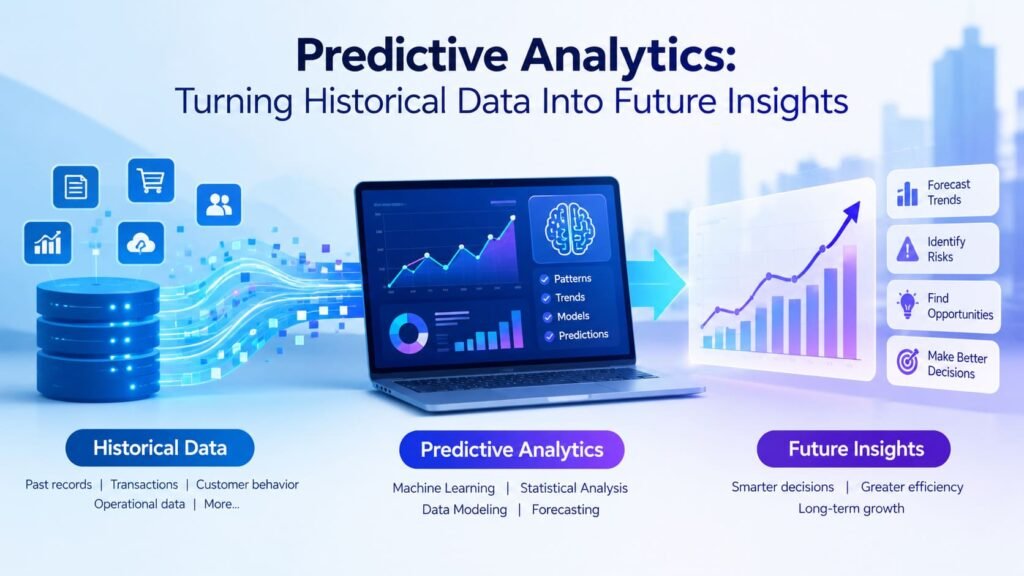
Predictive analytics is the process of examining historical and current data to estimate possible future outcomes. It combines statistical techniques, machine learning, artificial intelligence, and data analysis to identify patterns that might otherwise go unnoticed.
Businesses generate information through sales transactions, customer interactions, website activity, financial records, and everyday operations. When this information is collected and analysed properly, it can reveal useful details about future business requirements.
For example, a retail company can examine previous sales records to estimate which products customers may purchase during the upcoming festive season. Similarly, a manufacturing business can analyse equipment performance to identify early signs of possible machine failures.
The importance of predictive analytics lies in helping businesses move beyond simply understanding what has already happened. It allows them to consider what could happen next and prepare their strategies accordingly.
1. Understanding Customer Behaviour and Changing Expectations
Customer preferences can change without much warning. A product that attracts attention today may become less popular when new alternatives enter the market or customer expectations change.
Predictive analytics helps businesses understand these changes by examining customer purchase history, browsing patterns, feedback, and previous interactions.
For example, an online shopping platform can analyse the products customers frequently search for and purchase. Based on these patterns, the company can identify products that may attract more interest in the coming months.
This information helps businesses create relevant marketing campaigns, improve product recommendations, and develop better customer experiences.
Understanding customers before their needs change can also help companies build stronger relationships and improve customer retention.
2. Making More Informed Business Decisions
Every important business decision involves some level of uncertainty. Expanding into a new market, introducing a product, or investing in new technology requires careful planning.
Predictive analytics helps decision-makers examine previous business performance and identify possible future outcomes before taking action.
For instance, a company planning to open a new branch can study regional sales trends, customer demand, purchasing behaviour, and operating expenses. These insights can help management evaluate whether the proposed location offers a realistic business opportunity.
Instead of depending entirely on assumptions, businesses can use available information to support their decisions.
This approach makes planning more structured and helps organisations understand potential challenges before making major commitments.
3. Identifying Market Trends and New Opportunities
Markets are constantly changing. New technologies, customer interests, competitor activities, and economic conditions can influence how businesses operate.
Predictive analytics allows companies to examine market information and recognise patterns that may indicate emerging opportunities.
For example, a company selling electronic products can analyse customer searches and previous sales to identify growing interest in a particular product category.
These findings can help the business prepare its inventory, review its marketing strategy, and adjust its product offerings before demand increases.
Identifying these opportunities early can give businesses more time to respond to market changes and make strategic improvements.
4. Reducing Business Risks Before They Become Serious
Unexpected problems can affect almost every part of a business. Financial difficulties, delayed deliveries, equipment breakdowns, and declining customer satisfaction can create significant challenges.
Predictive analytics helps businesses recognise warning signs by identifying unusual patterns in their data.
For example, a financial services company can examine payment histories to identify accounts that may have a higher risk of delayed payments. A manufacturing company can analyse machine performance records to identify equipment that may require maintenance.
Recognising these patterns early gives businesses an opportunity to take preventive action.
Although predictive analytics cannot eliminate every business risk, it can help organisations prepare more effectively and reduce the impact of avoidable problems.
5. Improving Inventory Management and Demand Forecasting
Managing inventory is a common challenge for businesses. Keeping excess stock increases storage expenses, while insufficient stock can result in lost sales and unhappy customers.
Predictive analytics helps companies estimate future product demand by analysing previous sales, seasonal trends, customer behaviour, and purchasing patterns.
For example, a supermarket can study previous festive-season sales to estimate how much additional stock may be required for particular products.
With better demand forecasting, businesses can:
- Maintain appropriate inventory levels.
- Reduce unnecessary storage expenses.
- Avoid frequent product shortages.
- Improve purchasing and supply planning.
- Manage resources more efficiently.
This allows businesses to prepare for changes in demand rather than reacting after inventory problems occur.
6. Strengthening Financial Planning and Budget Management
Financial planning requires businesses to understand their current position while preparing for future expenses and revenue requirements.
Predictive analytics can help companies examine historical revenue, operating costs, payment patterns, and financial performance to estimate possible future financial conditions.
For example, a growing organisation can analyse previous monthly expenses and revenue trends to estimate its financial requirements for the next quarter.
These insights can help management identify potential cash flow challenges, review spending priorities, and allocate budgets more carefully.
When financial decisions are supported by reliable data, businesses can develop more realistic budgets and prepare for unexpected expenses.
7. Preparing Employees and Business Operations for Future Needs
Business growth often creates new demands on employees, technology, and operational resources. Without proper preparation, organisations may struggle to manage increasing workloads.
Predictive analytics can help managers estimate future staffing requirements by examining employee workloads, project schedules, customer demand, and operational performance.
For example, a customer support company can study previous enquiry volumes to estimate how many employees may be needed during a busy season.
This allows management to plan recruitment, distribute responsibilities, and improve workforce utilisation.
Better operational planning also helps businesses avoid unnecessary pressure on existing employees while maintaining service quality.
Challenges Businesses May Face When Using Predictive Analytics
Although predictive analytics offers several advantages, businesses need to understand the challenges involved before implementing it.
Poor Data Quality: Incomplete, outdated, or inaccurate information can produce unreliable predictions.
Data Privacy and Security: Companies must protect customer and employee information and follow applicable data protection requirements.
Implementation Costs: Analytical software, technical infrastructure, and skilled professionals may require considerable investment.
Lack of Technical Knowledge: Employees need appropriate training to understand analytical results and use them effectively.
Unpredictable Market Changes: Historical patterns cannot always account for unexpected economic events, new competitors, or sudden changes in customer behaviour.
To overcome these challenges, businesses should focus on maintaining accurate data, selecting suitable analytical tools, and regularly reviewing their prediction models.
How Businesses Can Start Using Predictive Analytics
Companies do not need to transform their entire operations immediately to benefit from predictive analytics. They can begin with a specific business challenge and gradually expand their use of data analysis.
Some practical starting points include:
- Identify a Business Goal: Decide whether the priority is understanding customer demand, reducing costs, improving sales, or managing operational risks.
- Collect Reliable Data: Gather relevant information from existing business systems and ensure that it is accurate and up to date.
- Choose Suitable Analytical Tools: Select tools that match the organisation’s requirements, available resources, and technical capabilities.
- Analyse Patterns: Examine historical information to identify trends and relationships that may help estimate future outcomes.
- Review and Improve Predictions: Compare predicted outcomes with actual results and update analytical models when necessary.
Starting with a clear objective makes predictive analytics easier to implement and helps businesses understand its practical value.
What Does the Future of Predictive Analytics Look Like?
The future of predictive analytics is closely connected with developments in artificial intelligence, machine learning, and business intelligence.
As analytical technologies improve, businesses may be able to examine larger amounts of information, recognise patterns more quickly, and respond to changing conditions with greater confidence.
Predictive analytics is likely to become increasingly useful in areas such as customer experience, supply chain management, financial planning, manufacturing, and marketing.
However, technology alone cannot guarantee better business decisions. Human experience, industry knowledge, and careful judgement will remain important when interpreting predictions.
Businesses that combine reliable information with practical decision-making will be in a stronger position to prepare for future challenges and opportunities.
Conclusion
Preparing for the future is an ongoing responsibility for every business. Customer expectations change, market conditions evolve, and new challenges can appear when organisations least expect them.
Predictive analytics helps companies understand these possibilities by turning historical and current information into useful insights. From improving customer experiences and forecasting demand to managing financial risks and planning resources, it can support better decision-making across different business functions.
The real value of predictive analytics is not in predicting every future event correctly. It is in helping businesses recognise possible changes early, prepare suitable strategies, and make decisions with greater confidence.
Frequently Asked Questions
1. How does predictive analytics help businesses?
It helps businesses forecast trends, understand customers, and make better decisions.
2. What data is used in predictive analytics?
It uses sales records, customer behaviour, market trends, and historical business data.
3. Is predictive analytics useful for small businesses?
Yes, it helps small businesses plan sales, manage inventory, and reduce expenses.
4. Can predictive analytics predict future market trends?
It can identify patterns and estimate possible market trends using historical data.