
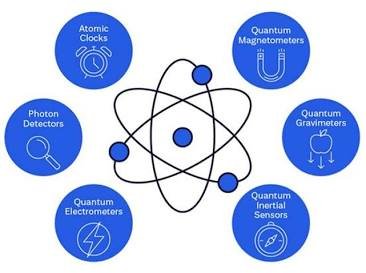
Many important changes in our world happen on a scale that ordinary instruments struggle to measure. A magnetic field may shift slightly, a material may experience a tiny structural change, or a faint signal may travel through space without being detected by conventional equipment. These changes might appear insignificant, but they can provide valuable information for scientific research, medical studies, and advanced technology.
This is where quantum sensors are attracting attention. By using the unusual properties of atoms, electrons, and light, these sensors can measure extremely small variations in their surroundings. Their purpose is not simply to make instruments more powerful, but to help researchers investigate signals that would otherwise remain difficult to observe.
Quantum sensing is already being explored and used in areas such as medical research, astronomy, geology, and precision measurement. As the technology develops, it could change how scientists study the human body, explore underground resources, and investigate the physical world.
What Are Quantum Sensors?
A quantum sensor is a device that uses the principles of quantum physics to measure a physical quantity. Depending on its design, it can detect changes in magnetic fields, electric fields, temperature, acceleration, gravity, or light.
Ordinary sensors are useful for countless everyday tasks. Thermometers measure temperature, compasses indicate direction, and electronic instruments monitor pressure or movement. However, every measuring device has limits. When a signal becomes extremely weak or a change is very small, the instrument may struggle to distinguish it from background noise.
Quantum sensors approach this challenge differently. They use carefully controlled quantum systems whose properties respond to external conditions. Scientists then measure those responses to determine what has changed.
For example, certain atomic systems respond to magnetic fields through changes in their quantum states. By observing these changes, researchers can estimate the strength of a magnetic field with high precision.
The key advantage is that quantum physics provides measurement techniques that can be exceptionally sensitive under suitable conditions. However, not every quantum sensor outperforms every conventional instrument. Its effectiveness depends on what is being measured, the environment, and the design of the device.
How Do Quantum Sensors Detect Invisible Changes?
The idea behind quantum sensing becomes easier to understand when we look at how these devices interact with their surroundings.
1. Using Atoms as Sensitive Measuring Systems
Atoms have specific energy levels and other physical properties that scientists can study with remarkable precision. When an external influence changes those properties, the difference can provide a measurable signal.
Imagine researchers want to measure a magnetic field that is too weak for a less sensitive instrument to distinguish reliably. In an atomic quantum sensor, the magnetic field can influence the behavior of atomic spins. Scientists use carefully controlled light or other measurement techniques to observe the response.
The resulting data can reveal small variations in the field. Similar principles can help researchers investigate magnetic properties in materials and study weak biological signals.
2. Measuring Changes in Light
Light is another important part of quantum sensing. Rather than treating it only as a continuous beam, scientists can use its quantum properties to measure extremely faint signals.
Some specialized detectors can register individual photons, the smallest discrete units of light. This capability becomes valuable when an instrument must examine a dim source that produces very few detectable photons.
For example, astronomers studying distant objects may receive only a limited amount of light. Highly sensitive photon detectors can help them collect useful information from these faint signals.
The same general approach also supports experiments in quantum communication, optical research, and advanced imaging.
3. Detecting Tiny Changes in Motion and Gravity
Quantum sensors can also help measure acceleration, rotation, and gravitational effects. Some devices use atoms that behave like waves under carefully controlled conditions. When the atoms experience motion or gravity, their wave patterns can change.
Scientists measure these changes to calculate the physical quantity they want to study.
This technique could improve certain forms of navigation and help researchers investigate underground structures. For example, small variations in gravity may provide clues about differences in the density of rocks beneath the Earth’s surface.
These measurements do not automatically identify a specific underground object. Researchers still need to interpret the data and account for other possible causes of the signal.
Where Could Quantum Sensors Make a Difference?
The potential value of quantum sensors becomes clearer when we consider the problems they may help solve.
Medical Research and Brain Activity
The human body produces electrical activity and associated magnetic fields. Some of these magnetic signals are extremely weak, making them difficult to measure without specialized equipment.
Highly sensitive quantum magnetometers could help researchers detect and study magnetic signals associated with brain activity and the heart. Such measurements may support research into neurological processes and improve certain approaches to medical investigation.
For instance, magnetoencephalography measures magnetic fields produced by electrical activity in the brain. Some systems use superconducting quantum interference devices, commonly known as SQUIDs, to detect these faint signals.
However, advanced quantum sensors are not a universal replacement for existing medical equipment. Practical use depends on sensitivity, operating conditions, cost, and the specific medical application.
Finding Underground Minerals and Structures
Exploring what lies beneath the ground can be difficult and expensive. Traditional surveys use techniques such as magnetic measurements, seismic waves, and electrical methods to investigate underground conditions.
Quantum sensors could add another useful source of information. Sensitive gravity and magnetic instruments may detect subtle variations associated with changes in underground rock formations.
These measurements could help geologists narrow down areas for further investigation. They may also support research into mineral deposits and certain buried structures.
The main benefit is the possibility of collecting more detailed measurements without relying entirely on direct excavation. Even so, a sensor reading alone cannot confirm the presence of a mineral deposit. Geological analysis and additional testing remain important.
Improving Navigation When GPS Is Unavailable
Navigation systems often depend on satellite signals. In tunnels, underwater environments, and some remote locations, receiving reliable GPS signals can be difficult or impossible.
Quantum-based accelerometers and gyroscopes are being investigated as ways to measure movement and orientation with high precision. By tracking motion over time, these instruments could help navigation systems estimate their position without continuously relying on satellite signals.
Such technology may eventually benefit aircraft, ships, autonomous systems, and scientific expeditions.
There is an important limitation: small measurement errors can accumulate as a navigation system continues estimating movement. Quantum sensors may reduce certain errors, but they do not eliminate every source of drift or guarantee perfectly accurate positioning.
Studying Space and the Early Universe
Space research often involves signals that are extremely faint by the time they reach a telescope. Detecting individual photons or measuring their energy accurately can provide scientists with information that would otherwise be lost.
Specialized quantum detectors are being developed for astronomy and fundamental physics. They can help researchers study faint radiation, investigate the properties of distant objects, and search for evidence relevant to unanswered questions about the universe.
Some experiments also use highly sensitive detectors to investigate dark matter candidates or other phenomena that produce very weak signals.
These applications require careful experimentation. Detecting a faint signal does not necessarily establish a new discovery; scientists must rule out background interference and confirm that the result is consistent with the phenomenon being investigated.
Monitoring Advanced Materials and Industrial Equipment
Manufacturers rely on accurate measurements to understand how materials behave under stress, heat, magnetic fields, and other operating conditions.
Quantum sensors may help researchers identify subtle changes in the properties of advanced materials. Depending on the sensor, these measurements could support laboratory testing, electronics development, or the investigation of new materials.
In industrial environments, sensitive monitoring could also help identify unusual physical changes that deserve further inspection.
However, practical deployment requires sensors that can operate reliably around vibration, temperature fluctuations, dust, and electromagnetic interference. A device that performs exceptionally well in a controlled laboratory may need substantial engineering before it becomes suitable for a factory.
Quantum Sensors vs. Ordinary Instruments
Quantum sensors and conventional instruments serve many of the same purposes, but they can differ in how they measure physical quantities.
| Feature | Conventional Sensors | Quantum Sensors |
|---|---|---|
| Measurement method | Uses established physical and electronic principles | Uses quantum properties of atoms, light, or other systems |
| Sensitivity | Depends on sensor design and operating conditions | Can offer exceptional sensitivity for particular measurements |
| Operating environment | Often designed for practical, everyday conditions | Some require carefully controlled environments |
| Common uses | Temperature monitoring, pressure measurement, and industrial control | Precision magnetic sensing, specialized light detection, and advanced navigation research |
| Main challenge | Limited sensitivity, resolution, or calibration stability in some applications | Cost, complexity, environmental noise, and practical integration |
Neither approach is automatically superior in every situation. A conventional sensor may be more affordable, durable, and convenient for everyday monitoring. A quantum sensor becomes attractive when its particular measurement capabilities provide a meaningful advantage.
What Challenges Must Scientists Overcome?
Despite their promise, quantum sensors face several challenges before they can become widely available.
Environmental noise: Temperature changes, vibration, and unwanted electromagnetic fields can interfere with sensitive measurements. Scientists must separate the signal they want from these disturbances.
Cost and complexity: Certain quantum sensors require lasers, specialized electronics, vacuum systems, or extremely low operating temperatures. These requirements can make the equipment expensive and difficult to maintain.
Size and portability: Laboratory instruments may be large and delicate. Developing smaller, robust devices that can work outside controlled research settings remains an important engineering goal.
Data interpretation: Detecting a small change is only the beginning. Researchers must determine whether the measurement reflects the phenomenon they are investigating or another environmental effect.
Real-world reliability: A sensor must produce useful results repeatedly, not just during a successful experiment. Calibration, long-term stability, and integration with existing systems all matter.
Addressing these challenges will help determine which quantum sensing technologies become practical tools and which remain primarily research instruments.
What Does the Future of Quantum Sensing Look Like?
The future of quantum sensing is likely to involve a combination of improved measurement precision and more practical device designs.
Researchers are exploring ways to make quantum systems less vulnerable to environmental disturbances. Others are working on compact sensors that can operate outside specialized laboratories. Advances in optical systems, materials science, and signal processing may also help make quantum measurements more accessible.
Another promising direction is the development of sensor networks. Instead of relying on a single instrument, researchers could combine measurements from multiple sensors to build a more detailed picture of an environment.
For example, a network of sensitive instruments might help scientists map variations in magnetic fields or gravity across a region. Combining these readings could reveal patterns that would be difficult to understand from one measurement alone.
The real progress will come when these systems provide reliable, useful information at a cost that makes sense for their intended applications.
Conclusion
Quantum sensors offer a new way to investigate changes that are difficult for ordinary instruments to measure. By using the properties of atoms, electrons, and photons, they can help scientists detect weak magnetic fields, measure faint light, study motion, and investigate subtle variations in the physical world.
Their potential reaches across medical research, geology, astronomy, navigation, and advanced manufacturing. Yet their success will depend on more than impressive laboratory sensitivity. Researchers must also address cost, environmental interference, reliability, and the challenge of interpreting complex measurements.
As the technology matures, quantum sensors could become valuable tools for answering questions that currently require more limited or indirect measurements. They will not replace every conventional instrument, but in situations where tiny changes carry important information, they may allow scientists to see much more than they could before.
Frequently Asked Questions
1. What are quantum sensors?
Quantum sensors are devices that use quantum physics properties of atoms, electrons, or light to measure physical quantities such as magnetic fields, gravity, acceleration, and temperature with high precision.
2. How can quantum sensors detect changes that ordinary instruments miss?
Quantum sensors measure how quantum systems respond to small environmental changes. By analyzing these responses, researchers can detect weak signals that may be difficult for conventional instruments to distinguish from background noise.
3. Where can quantum sensors be used?
Quantum sensors have applications in medical research, underground exploration, astronomy, navigation, and advanced materials testing. Their usefulness depends on the sensor type and the measurement conditions.
4. What are the main challenges of quantum sensors?
The main challenges include high costs, environmental interference, complex operating requirements, and the need for reliable calibration. Researchers are working to make these sensors smaller, more affordable, and suitable for real-world applications.