
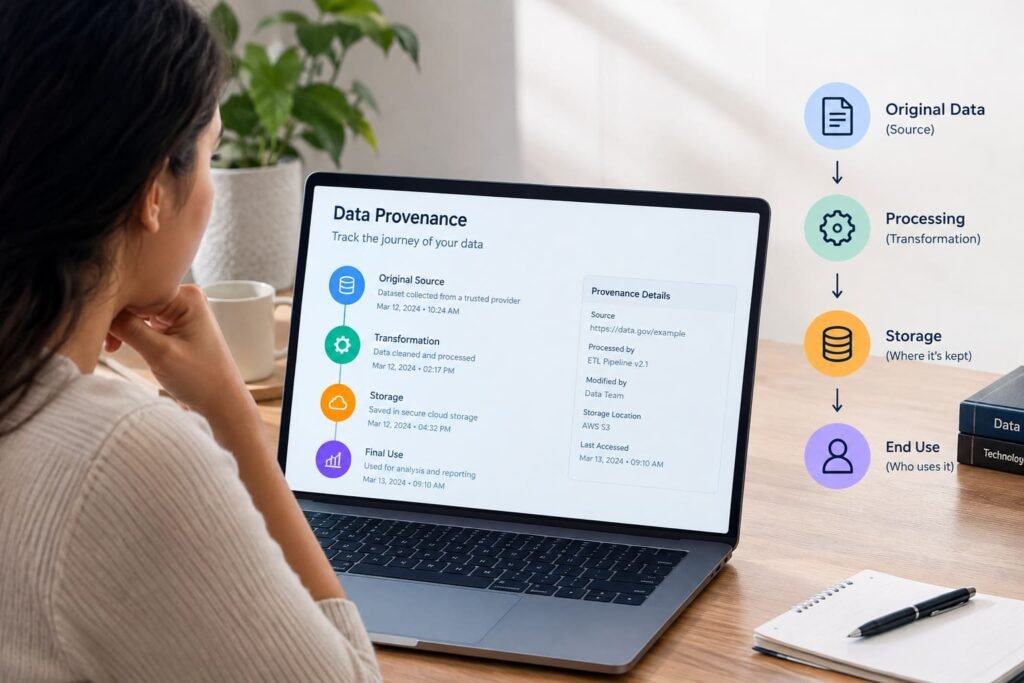
Every day, organizations collect information from websites, applications, customer databases, sensors, surveys, and many other sources. But collecting data is only one part of the process. To trust that information, people also need to understand where it came from, how it changed, and how it reached its current destination.
This is where data provenance becomes important.
Data provenance helps organizations trace the history of information from its original source to its final use. It provides a clearer picture of how data moves through different systems, which transformations have been applied, and which processes depend on it.
As businesses increasingly rely on analytics, artificial intelligence, and automated decision-making, understanding data origins is becoming an important part of maintaining reliable information.
What Is Data Provenance?
Data provenance refers to the documented history and origin of a piece of data. It explains where the information was created or collected, how it was processed, which systems handled it, and where it was eventually used.
Think of it as a record of a data item’s journey.
For example, a company might collect customer information through its website, transfer it into a database, clean the records, and use the resulting dataset to prepare a sales report. Data provenance helps explain each stage of that process.
Without this history, a team might see an unexpected number in a report but struggle to determine whether the problem came from the original data, a processing step, or a reporting error.
Data provenance is useful across industries, including healthcare, finance, scientific research, retail, manufacturing, and information technology.
Why Does Data Provenance Matter?
Data is often shared across multiple teams and applications. As it moves between systems, it may be filtered, combined, reformatted, or corrected. Keeping track of these changes can become difficult without a clear record.
Data provenance helps solve this problem in several ways.
1. Improving Data Quality
When a dataset contains missing values, duplicate records, or unexpected results, teams need a reliable way to investigate the cause.
Provenance records can help identify the original source and the processing steps that may have introduced an error. This makes troubleshooting more systematic and reduces the need to investigate every part of a data pipeline manually.
2. Building Trust in Reports and Analytics
Business decisions often depend on dashboards, performance reports, and forecasts. If the numbers cannot be traced to their sources, users may question whether the results are reliable.
Data provenance provides supporting context. Analysts can examine the datasets and transformations behind a report instead of treating its results as unexplained figures.
3. Supporting Audits and Compliance
Some organizations must demonstrate how particular information was collected, processed, or used. This can be especially important when handling sensitive records or working under industry-specific regulations.
Provenance documentation can support internal reviews and audits by providing evidence of data movement and processing history. However, provenance alone does not guarantee legal compliance; organizations must also follow the relevant rules and controls.
4. Making AI Systems More Transparent
Artificial intelligence systems depend on data for training, testing, and generating predictions. If the origin or processing history of that data is unclear, it becomes harder to investigate unreliable outputs or potential biases.
Tracking data provenance helps teams understand which datasets were used, how they were prepared, and whether their sources were appropriate for the intended application.
5. Reducing Troubleshooting Time
A problem in a final report may originate several steps earlier in the data pipeline. Without a record of those steps, teams may spend hours checking unrelated systems.
Provenance makes it easier to trace dependencies and narrow the investigation to the most likely source of the problem.
How Does Data Provenance Work?
Data provenance is usually created by recording relevant information throughout the data lifecycle. The exact process depends on the organization’s systems and the type of information being managed.
Step 1: Identify the Original Data Source
The first step is to record where the data originates. Sources might include a customer relationship management system, a spreadsheet, an application programming interface, a laboratory instrument, or a public dataset.
Useful details may include the source system, collection date, dataset identifier, and responsible process.
Step 2: Record Data Transformations
Raw data rarely moves directly into its final use. It may be cleaned, filtered, combined with other datasets, converted into a different format, or enriched with additional information.
Recording these operations helps explain why the final dataset may differ from the original version.
Step 3: Track Movement Between Systems
Organizations frequently transfer data between databases, cloud storage platforms, analytics tools, and business applications.
Tracking these transfers helps establish which systems handled the information and how different datasets are connected.
Step 4: Maintain Version and Processing Records
When a dataset is updated, it is useful to preserve information about the change. Records may include timestamps, processing job identifiers, software versions, and references to the input and output datasets.
These details can help teams reproduce a result or compare different versions of the same data.
Step 5: Make Provenance Information Accessible
Recording provenance is most useful when authorized users can find and understand it. Organizations may store this information in metadata catalogs, data lineage platforms, workflow logs, or specialized provenance systems.
Access controls should protect sensitive information, and documentation should be maintained as systems and workflows change.
A Real-World Example of Data Provenance
Consider an online retailer that wants to understand why its monthly sales report shows a sudden decline.
The sales figures come from several systems. Orders are collected through an e-commerce platform, payment information is processed separately, and product data is stored in an inventory database. These sources are combined to create a reporting dataset.
With data provenance, analysts can trace the report back through each stage.
They may discover that the decline occurred because a recent data-processing change excluded orders with a particular status. The original sales records were still available, but the transformation produced an incomplete reporting dataset.
By identifying the specific processing step, the team can correct the problem and check whether earlier reports were affected.
This example demonstrates the practical value of provenance: it does not automatically prevent mistakes, but it helps people understand what happened and where corrective action is needed.
Data Provenance vs. Data Lineage
Data provenance and data lineage are closely related, but they emphasize different aspects of data history.
Data provenance focuses on the origin, history, and supporting context of information. Data lineage focuses more specifically on how data moves between systems and how it is transformed along the way.
For example, provenance may document the source of a research dataset, who collected it, and which processing steps were applied. Lineage may show how that dataset flows through a pipeline into a database and eventually appears in a dashboard.
In practice, organizations often use both concepts together. Their precise meanings can vary between tools and teams, so clear definitions are helpful when establishing a data management process.
Common Challenges in Tracking Data Provenance
Although provenance offers several benefits, implementing it across a complex data environment requires planning.
Disconnected systems: Information may pass through applications that do not share metadata or logging standards. Integrating these systems can require additional engineering work.
Incomplete records: If a process does not capture its inputs, outputs, or transformations, the data history may contain gaps.
Growing data volumes: Large data environments can generate substantial amounts of metadata. Organizations need suitable storage, retention, and search strategies.
Legacy infrastructure: Older applications may not support automatic provenance tracking, making some records dependent on custom integrations or manual documentation.
Privacy and access concerns: Provenance records may reveal sensitive source names, data relationships, or operational details. Access should be managed carefully.
A practical approach is to start with important datasets and critical workflows, then expand coverage as the organization’s requirements and capabilities develop.
Best Practices for Implementing Data Provenance
Organizations do not necessarily need to track every detail from day one. A focused implementation can provide meaningful value without creating unnecessary complexity.
- Start with critical datasets: Prioritize information used for financial reporting, customer analytics, scientific research, or AI applications.
- Automate metadata collection: Use available platform features and pipeline integrations to reduce reliance on manual records.
- Standardize documentation: Establish consistent names and formats for sources, transformations, timestamps, and dataset versions.
- Define ownership: Assign responsibility for maintaining provenance records and resolving gaps.
- Protect sensitive information: Apply appropriate access permissions and retention policies.
- Review records regularly: Check that provenance remains accurate when pipelines, applications, and data sources change.
The goal is to create a dependable history of information that people can use to investigate problems and understand how results were produced.
The Future of Data Provenance
As organizations adopt more advanced analytics, distributed data platforms, and AI-powered applications, tracking data history is likely to become increasingly important.
Automated metadata collection, data catalogs, and lineage visualization tools can help teams build a clearer picture of complex data environments. In AI workflows, provenance can also support documentation of training datasets, evaluation data, and the processing steps behind model development.
However, technology alone is not enough. Reliable provenance also depends on consistent processes, clear ownership, appropriate access controls, and a commitment to maintaining accurate records.
Organizations that treat provenance as part of everyday data management will be better positioned to investigate errors, explain analytical results, and use information with greater confidence.
Conclusion
Data provenance provides a structured way to understand where information comes from and how it changes throughout its lifecycle. By documenting data sources, transformations, movement, and usage, organizations can investigate problems more effectively and improve confidence in their reports and analytical systems.
As data becomes central to business operations and AI development, knowing how information reached a particular result is just as important as the result itself. A well-planned provenance process helps turn data history into practical knowledge that supports more informed decisions.
Frequently Asked Questions
1. What is data provenance?
Data provenance tracks where data originates, how it is processed, and how it moves between systems.
2. Why is data provenance important?
It helps improve data quality, investigate errors, and build trust in reports and analytics.
3. What is the difference between data provenance and data lineage?
Data provenance focuses on data origins and history, while data lineage tracks its movement and transformations.
4. How can organizations track data provenance?
Organizations can record data sources, timestamps, transformations, and dataset versions using metadata tools.